Tuesday, August 6, 2013

UVA: Poster Child for Empty Promises and False Hopes

Just a few years ago, we the people of UW-Madison were hearing quite a bit about the flagship university of another state -- the University of Virginia.  Our Chancellor at the time, Biddy Martin, is from Virginia, and lauded UVA's efforts to gain autonomy from the state while also increasing affordability through its "Access UVA" program.

I vehemently and repeatedly disagreed with Martin's assessment of UVA and its "successes" at the time, but to little avail.  She managed to convince most of the university that a semi-divorce from the state would allow for financial flexibilities that would help to make college more affordable. While some of her plans were thwarted by the rest of Wisconsin, she got the vote of the Faculty Senate and to this day, many students and faculty speak of her efforts as if they made UW-Madison more affordable.

In point of fact, they did not, and today even the poster child she commended-- UVA-- fell to pieces. Access UVA will no longer be a grants program, instead it will be scaled back and shifted to include a sizable amount of loans.  Students from low-income families will graduate with $14,000 in debt (if they escape after just 4 years--unlikely) and other students with up to $28,000.

Access UVA, said President Teresa Sullivan, wasn't "sustainable."  There's an end-stop to her statement that makes you wonder if she and the school recognize that the result was not inevitable but rather stemmed directly from the political and policy choices made over the last decade.  Now UVA must face facts: its costs of attendance are high, its support from the state of Virginia is low, and it is going to ask students from poor families to graduate with debt amounting to a third or more of their families' annual income.  These things don't just happen.

High-tuition high-aid models of financing higher education were formulated and evaluated at a time when college students were on average wealthier, whiter, and smaller in number.  It was perhaps possible to feel proudly progressive about taking tuition from the top 75% and redistributing aid to the bottom 25% (or even 90/10).  No longer.  Today about 80% of students feel college is unaffordable, and yet they have to pay high tuition to make the top 20% happy in their glorified teeny-tiny classes, lush campuses, and elitist environments. Only a fraction of that 80% gets any significant grant aid, while the rest carry debt.  In this model, 80% of the students bear the brunt of the education of the top 20%, who escape from their college party years with debt that Mommy and Daddy pay off on graduation day.

The student leader at UVA who objected to these changes perfectly described the real underlying problem when he said "[but] there are increasingly few places left to streamline or cut back on to make these ends meet without impacting the quality of education or student experience.”   There it is-- we need to spend a lot to have high quality.  Affordability be damned.

Anyone who's taken a stroll across UVA's lawns knows that it would be perfectly possible to have a darned good college education for the students of the state at a fraction of what they are spending now. Sure, it wouldn't be the same-- but times they are changing. And it is far less tenable for colleges and universities to throw up their ivy-covered walls and say "sorry you cost too much" to poor students than to insist that they take action to lower their costs for all students, to make college opportunities for all Americans the realities they should and must be.


Monday, August 5, 2013

Thoughts About the Future of UW-Madison? Please Share!

We are welcoming a new chancellor to UW-Madison this fall, along with many other new leaders.  I have been receiving many emails from colleagues and students expressing feelings (both positive and negative) about campus life and the direction it is taking, and in response I will soon begin to host Room for Debate- style forums on key topics. The intention is to provide our community with a sense of the array of opinions, and share insights with our administrators-- including Chancellor Rebecca Blank.

I welcome your participation. Please email me at srab@education.wisc.edu with suggestions as to what questions the forums should be asking, and who you'd like to hear from.   This is open to anyone in the UW-Madison community, very broadly defined-- including community members, people working at other institutions, etc.

In addition, please email me if you are willing to contribute your opinion to the forums.  If you have a compelling reason to write anonymously (and there are many) I will be happy to publish you that way.

The first several forums will address these topics, so please let me know right away if you want to write about any of them:

1. How should the UW-Madison community work to ensure that its relationship with the people of the state of Wisconsin improves over the next 10 years?

2. What rules of conduct or guidelines should govern the interaction of private philanthropy, including UW Foundation, with UW-Madison?

3. What role should academic deans play with regard to academic departments moving forward?

4. How should UW-Madison work to create new leaders to fill administrative positions at the university in coming years?

Sunday, August 4, 2013

Lessons for Higher Ed from Health Care

The New York Times has been running a terrific series helping to illustrate why costs of healthcare in this country are so incredibly out of control. Today's story is masterful in the way it breaks down the cost of an artificial hip replacement in the U.S. versus Belgium.  The cost in the U.S. is over $78,000, while in Belgium it is $13,660.

The main cost differences lie in variation in the surgeon's fee (about 16 times higher in the U.S.), the implant cost (more than 8 times higher in the U.S.) and the hospital room cost (about 8 times higher on a per-night basis).  These differences helped direct the reporters towards a story that unpacks the reasons for variation in impact and hospital costs, while unfortunately saying little about the differences in surgeon's fees.

Imagine what we could learn from similar analyses of the costs of higher education in this country versus in others.   Time and again I hear that costs of education students at the postsecondary level are higher here than anywhere else, and it is very hard to believe that those costs explain our high (yet declining) ranking in terms of quality.

This quote in the Times article stood out to me as precisely the sort of thing we need to explore.  When an American traveled to Belgium for a far less expensive hip replacement, he entered a hospital and was initially concerned: I was immediately scared because at first I thought, this is really old.  The chairs in the waiting rooms were metal, the walls were painted a pale green, there was no gift shop. He flashed back to his recent visit to New York Presbyterian Hospital, which has comfortable waiting rooms, an elegant lobby and newsstands -- along with much, much higher prices. But then I realized everything was new. It was just functional. There wasn't much of a nod to comfort because they were there to provide health care.

Think about the last private college or public flagship campus you visited, and then think about your local comprehensive university or community college.  They are all there, purportedly, to provide education.  Yet the former are all about "comfort"-- and their influence is leading other institutions with far fewer resources to follow that path.  The question is, at what cost?

Take a look at this recent transformation of Madison Area Technical College -- which now calls itself Madison College. What if this happened to two-year colleges across the nation, most of which rely on underpaid college instructors for the actual educating? At what cost, and at what consequence?  Of course it's always wonderful to spend your days learning new things in beautiful places, but what if it means your neighbors can't afford an education at all?

Last year
This year

Sure, buildings and amenities aren't the whole story-- we really need the Times to unpack those discrepancies in surgeon fees.  We have to get to the bottom of our American obsession with equating amenities with quality in fields and services where the amenities are immaterial to the purposes.  And then we need to engage in appropriate comparative analyses to look for better solutions to our American higher education challenges.


Thursday, August 1, 2013

Student Power Converges on Madison

Starting today, the National Student Power Convergence is occupying UW-Madison.  My home department of Educational Policy Studies is a proud sponsor of this terrific event.  It is FREE, open to the public, and the place to be for the next 5 days.  UW Alum Maxwell Love, newly elected Vice-President of the United States Student Association, is a key organizer.

The agenda is entirely constructed by student organizers and aimed at sharing political and tactical analyses, and creating replicable campaigns to put student issues on the table in higher education nationwide.

Among the program highlights relevant for readers of this blog:

Friday August 2, 230-4 pm, Ingraham Hall Room 122 at UW-Madison
Student Debt: Dealing with Existing & Future Debt

Nelini Stamp as Moderator, Heather McGhee of Demos, Anne Johnson of Generation
Progress, Sami Alloy of Oregon Working Families Party, Scott Ross of One Wisconsin, and Sophia Zaman of United States Student Association

The millennial generation is the largest generation in American history, the most educated
generation in American history and the most indebted. The good news is that young
people around the country are pushing for the sweeping changes we need to tackle the
$1 trillion in student debt and make college more affordable and accessible for every student
and family. Check out this panel to hear from individuals and institutions involved in
the National Student Debt campaign.

Saturday August 3, 230-4 pm, Education L150 at UW-Madison
TAKING OVER YOUR STUDENT GOVERNMENT

Jalina Wayser of United States Student Association and New Jersey United Students

Just like power, student governments can be tools for the expression and manifestation of
your values. For this training, students from New Jersey United Students will draw on their experiences
of infiltrating and redirecting student governments to serve as hubs for organizing.

Saturday August 3, 230-4 pm, Ingraham Hall Room 116 at UW-Madison
HOW TO ORGANIZE ON CAMPUS: STUDENT DEBT 

Nelini Stamp of Working Families Party, Anne Johnson of Generation Progress

Mapping out Wall Street‘s Role on Campus will be a training on how to find the
different ways in which Wall Street has taken control of public higher education.
We will map out how to find endowment funds, board of governors/regents/
trustees that have ties to Wall St, and Wall Street on campus debit cards. This
will help give students tools to analyze the current power structure on campus.

Saturday August 3, 430-6 pm, Ingraham Hall Room 113 at UW-Madison
PUBLIC EDUCATION - ATTACKS & FIGHTING BACK

Jacob Chaffin of Ohio University Student Union, Stephanie Rivera of Students United
for Public Education, Israel Munoz and Ross Floyd of Chicago Student to Save
Our Schools, Jaysen Brazile of Newark Students Union, Anthony Ramirez of Voces
De La Frontera

College and high school students talk about the attacks on public K-12 education, the
fight back mounted by youth, communities, and teachers, and the role of college student
solidarity in the fight for public education.


Wednesday, July 24, 2013

Time with Teachers-- or What I Did on my Summer Vacation

I am a tenured professor, and this is July of my first-ever sabbatical.  According to many critics of higher education, I am currently sunning my buns on the shores of Bermuda, sipping cocktails and snacking on brie while the taxpayers labor at home to pay my salary.

On the contrary. I've just returned from a three-day trip to Indianapolis, where I joined more than 85 members of the Madison Metropolitan School District and the Boys and Girls Club of Dane County spending their unpaid time participating in AVID Summer Institute. Furthering their effort to get more students on track to college and career, these teachers and administrators spent their days actively focused on learning new pedagogical practices and acquiring new tools to bring home and put into place by fall.

They are nothing short of remarkable.

As we traveled to and from Indianapolis on a couple of big busses, sat in school team meetings around big conference tables, shared breakfast, lunch and dinner together, and waited in line for coffee, I got to talk with more public school teachers than I've ever encountered before in my life.  I listened closely to their casual conversations, hoping to gain insight into the sources of the laziness and ineptitude I've heard so much about. I waited to hear the voices conveying the soft bigotry of low expectations of their students, especially those students of color.  I watched and waited for them to doze off, unengaged as always in their work.

Ha!  As if. Let me tell you what these folks talked about, nonstop.

  • How to help the dozens of students for whom there isn't sufficient space in their under-funded, high-demand programs
  • How to spend adequate time with the long lines of students seeking help--now--at the end of each class period, while still making it to their next class
  • How to balance the desire to get involved in new programs while also covering their existing teaching loads
  • How to talk to parents about college possibilities without making them feel like failures if they could not afford to send their kids
  • How to explain to administrators why those chose to take on the "hardest cases" even though it would be "easier" to leave them behind
  • How to cope with racism in their communities without getting angry, so that they could help their students do the same
  • How to integrate innovations like AVID into their practice as they also cope with the Common Core, how to do it efficiently, and how to help others do the same
I compared notes with these teachers and found that compared to this university professor, they work very comparable hours, receive far more professional development and critique, have much less autonomy, and get paid but a fraction of what I earn.  I'm boggled that we can sleep at night knowing that we do not invest more in ensuring they will continue to do this hard work and are rewarded for it. I'm stunned that people pay so much money to higher education professors while demanding so little in the way of training, professional development, and evaluation of pedagogical practice in return. 

My time with teachers was one of the best moments of my summer.  My time with teachers was just the beginning.  In three days they made me their pupil.  I will continue to learn. 

Sunday, July 21, 2013

Comments on "Racial Segregation Patterns in Selective Universities"

Peter Arcidiacono of Duke University has been publishing a steady stream of papers examining the role of race in college admissions, with a particular focus on the effects of affirmative action.  I've discussed his work on this blog before, and given the substantial attention that generated, I'm sharing thoughts on another relatively new piece.

In the new paper, Peter and his colleagues suggest that friendships among students attending selective universities are no more likely to be interracial in composition than friendships in high school.  Of persistent racial segregation, they write:

"This is particularly true for blacks where on average their share of friends who are of another race is no higher in college than in high school despite their colleges having a much smaller share of black students than their high schools. However, the extent of interracial friendships, both before and during college, vary significantly depending on academic preparedness. The percentage of black friendships that are same-race is lower for those with SAT that are relatively low given the college they attend. Ordered probit estimates of the number of friends of different races show that, within a college, increasing one's own academic preparation makes inter-racial friendships with blacks less likely while increasing friendships with whites and Asians.

The multiple waves of friendship reporting ... tell a story of substantial racial isolation among blacks that slightly increases over time. Despite only comprising eight percent of the Duke student body, Black students report on average that 68% of their friends are black during their freshman year, a number which increases to 72% in their senior year. Ordered probit results again suggest that friendships with other races are more likely to occur the more similar one's academic preparation is to those of other races.

Taken as a whole, our results suggest that similarity in academic background is an important
determinant of interracial friendship formation. That black friendships are no more diverse in college
than in high school, despite blacks being substantially less-represented in their colleges, points
to a potential cost of a ffirmative action. Namely, by introducing a mismatch between academic
backgrounds of di fferent groups, interaction between these groups is discouraged."

I have several concerns with how the authors reach their conclusions and the policy implications they draw.

1. Their assumption seems to be that where educational settings have fewer black students, those students will be more likely to have interracial friendships.  Why expect this and not the opposite?Couldn't scarcity lead to a survivalist instinct to focus on key friendships among people who might seem to come from similar places?

2. The (very modestly) increasing isolation of the black students at Duke could be due to any number of factors, including campus racial climate. In this paper there are no tests for competing explanations other than academic mismatch. And the authors make nothing of the increasing segregation of white students from black friends as well- the % of white students with black friends as freshmen falls from freshman to senior year.  Moreover, the biggest increases in isolation are among Asian students-- as freshmen, 41% of their friends are Asian, but by senior year that is up to 48%.

3. There is no evidence that the observed relationship between academic "mismatch" and friendship composition is causal. It is quite a leap to suggest that racial segregation of friendships directly results from affirmative action.  In other words, there is little overlap between the empirical tests in this paper and the policy conclusions.  The authors conclude the paper with some words that suggest they know this-- and yet they make the policy statement in their opening abstract with direct and inflammatory language, stating that affirmative action plans "drive a wedge between the academic characteristics of different racial groups" creating problems for friendships.

4. The authors do not explain what their intended alternative policy might be.  Without affirmative action there would be fewer minority students on campus at all-- given their concern with friendship integration, what would the authors suggest happen then?


Tuesday, July 16, 2013

Will the Campuses Crumble? A Dream of the Future involving Detroit, Mad Men, and Samuel Clemens

This post is authored by R. Thomas, a graduate student at the University of Wisconsin-Madison.


There’s a lot of talk these days about university reform, and coursing through it I see a beautiful and tragic dream of the future.  Dreams, of course, meld idiosyncratic images and mine blends Detroit, Mad Men, and the great speeches of Samuel Clemens. 

We all know the story: Boosters of online education suggest that American higher education should rely upon a small group of superstar lecturers, computer-based grading systems and thousands of adjunct graders to deliver content to the masses. To benefit from economies of scale, some say we ought to have centralized national committees that decide what gets taught and who gets to teach it. Advocates claim online education will cut costs, improve educational outcomes, and bring higher education to underserved populations.

Such efforts carry the excitement of novels for me. As in Mad Men, the details of work and visions of the future are riddled with action and curiosity.  Much of the drama, of course, comes in waiting to see what will happen. Will we break social hierarchies, educate every American, and revitalize a lagging economy?  On the job front, will employers readily hire people with online degrees?  Will we create an exceptionally creative and dynamic economy with online education or add to the legions of overeducated and underemployed young people? And what will happen to the humanities, challenged as they are to bring engaging discussion online? Will they be too expensive to deliver and thus rendered irrelevant?   Finally, how will professors respond to these online reform efforts? Some Harvardprofessors have pushed back against EdX, but will they succeed? 

Of course, as in Mad Men, many of the characters are compelling and hard to ignore. Most players pursue admirable aims, while a few see profit at every turn. Technical wizards test the boundaries of possibility on a daily basis. Finally, for intrigue, we have one prominent voice whose book describes his genius and 6’8” stature as well as his passion for greater access.  And don’t forget the eminent MOOC professorwho aped Wal-Mart management when asked to address his responsibility to the academic community. Finally, I’m sure if we looked hard enough, we'd find plenty of romance.
 
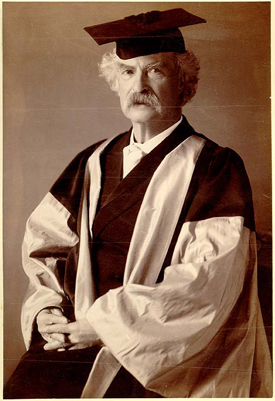
Woven through this drama are the fantastic lectures of Samuel Clemens. In the future, students will have nothing but the most exciting, engaging, and informative professors. We've all had amazingly inspiring teachers but also think of the dull ones: the ones that mumbled, yawned, or trailed off into empty confused space, blankly staring back at their audience of students. With MOOCs everyone will be taught by Samuel Clemens. Just as he regaled audiences around the world with stories of adventure and love, dynamic professors like Ann Swindler and Harold Scheubwill turn tedious degree requirements into something exciting, engaging, and memorable.  University education will be as entertaining as it is informative. Students will have not just a few memorable professors but rather four consistent years of intellectual challenge, adventure, and stimulation. Graduates will emerge with minds polished sharp and appetites expecting the best. Why shouldn’t universities be as good as multiple seasons of Mad Men?  Perhaps they will be…

However, the specter of Detroit and other post-industrial cities looms just out sight, haunting these dreams.  Walking around campus at the University of Wisconsin-Madison the place would seem to last forever. Grand and bland buildings alike bustle with life, looking impenetrable to change. Construction never stops and thousands of eager applicants are rejected each year. And yet, I imagine this same assurance was felt by workers in Detroit, Cleveland, and Milwaukee during the 1950s and 60s. On their evenings off from Pittsburgh steel plants, my grandparents drove new cars around a dynamic city, stopping here to eat an ice cream or there to dance the jitterbug.  On weekends, they strolled down crowded Braddock Avenue for Catholic mass and later Sunday brunch. All of this is gone of course. Much of Pittsburgh, like Detroit, is a wasteland. Braddock Avenue is an icon of post-industrial America, its crumbled buildings photographed as ruin porn. My grandparents’ cathedralsnow have collapsed roofs, and the mansions of the elite lean on dilapidated foundations, smiling back with broken windows. 

Will lecture halls, our hallowed cathedrals of learning, sit dormant, fade, and eventually crumble to the ground? Of course they will.  Why should a thousand different sociology professors teach Introduction to Sociologyevery fall when the best professors from Berkeley, Princeton, Yale and UNC-Chapel Hill could take turns teaching to the entire country?

Will universities become internet-photo-curiosities, idle distractions from work-a-day routines? It’s quite possible.  As undergrads, friends and I explored abandoned amusement parks along the Jersey shore, photographing roller coasters and conjuring various ghosts creeping through fun-homes and tunnels-of-love.  You may have explored other ruins, forgotten castles or asylums perhaps.  It’s easy to imagine wealthy young people doing the same years from now, walking around abandoned campuses with overgrown grass and broken windows.  They will photograph the collapsed arches of our lecture halls and wonder what it was like to sit for an hour in those hard wooden chairs.  They’ll do their best to envision crowds of students rushing to class. 

Like any good historical drama, this dream’s actors are vividly human, their efforts creative and disturbing. Such a future is exciting and beautiful, but it is also tinged with tragedy. Poised as we are on the brink of a new future, you can almost see Samuel Clemens watching us in white with a bushy mustache, smirking, “Never let the campus get in the way of your education.”