While watching the annual Gates Postsecondary Education Convening from afar via twitter, I am struck by the apparent absence of discussion about several core underlying issues keeping more students from succeeding in earning college degrees.
We cannot increase the success of undergraduates from disadvantaged backgrounds without ensuring that they are safe, healthy, and ready to learn. Food insecurity is a growing problem in higher education, as revealed by institutional surveys, and hopefully soon tracked by national data (I'm working on it).
Idea #1: Institute a free/reduced price breakfast and lunch program at all public colleges and universities where at least 1 in 3 students receives a Pell Grant.
Far too many of today's faculty are ill-equipped to teach the students of tomorrow. The focus on research has trumped the emphasis on high-quality teaching even at institutions with no research mission.
Idea #2: Make teaching a priority in public higher education.
a. Require that all new hires have teaching experience of some kind.
b. Require a pedagogical talk in the hiring process.
c. Require bi-annual professional development credits.
There is a well-known and very basic resource problem in higher education. The fewest dollars flow to the neediest students. Per student spending of about $6000 in community colleges is a travesty.
Idea #3: Focus funding where it can do the most good. Require that all states receiving any Title IV financial aid maintain adequate per-student spending at their community colleges. Based this on appropriate adequacy funding studies done by state.
None of these answers involve technology, I know. None speak to "quality" because I do not think the evidence on declining quality is solid-- the demographic changes in higher education have collided with the redefining process, and thus it is far from clear that reformers are saying anything more than "these students" aren't as good as yesterday's.
Without three these reforms in place, I don't think the technological solutions constitute anything more than tinkering towards utopia, and any efforts to cut costs could do more harm than good.
Showing posts with label higher education. Show all posts
Showing posts with label higher education. Show all posts
Friday, September 20, 2013
Sunday, August 4, 2013
Lessons for Higher Ed from Health Care
The New York Times has been running a terrific series helping to illustrate why costs of healthcare in this country are so incredibly out of control. Today's story is masterful in the way it breaks down the cost of an artificial hip replacement in the U.S. versus Belgium. The cost in the U.S. is over $78,000, while in Belgium it is $13,660.
The main cost differences lie in variation in the surgeon's fee (about 16 times higher in the U.S.), the implant cost (more than 8 times higher in the U.S.) and the hospital room cost (about 8 times higher on a per-night basis). These differences helped direct the reporters towards a story that unpacks the reasons for variation in impact and hospital costs, while unfortunately saying little about the differences in surgeon's fees.
Imagine what we could learn from similar analyses of the costs of higher education in this country versus in others. Time and again I hear that costs of education students at the postsecondary level are higher here than anywhere else, and it is very hard to believe that those costs explain our high (yet declining) ranking in terms of quality.
This quote in the Times article stood out to me as precisely the sort of thing we need to explore. When an American traveled to Belgium for a far less expensive hip replacement, he entered a hospital and was initially concerned: I was immediately scared because at first I thought, this is really old. The chairs in the waiting rooms were metal, the walls were painted a pale green, there was no gift shop. He flashed back to his recent visit to New York Presbyterian Hospital, which has comfortable waiting rooms, an elegant lobby and newsstands -- along with much, much higher prices. But then I realized everything was new. It was just functional. There wasn't much of a nod to comfort because they were there to provide health care.
Think about the last private college or public flagship campus you visited, and then think about your local comprehensive university or community college. They are all there, purportedly, to provide education. Yet the former are all about "comfort"-- and their influence is leading other institutions with far fewer resources to follow that path. The question is, at what cost?
Take a look at this recent transformation of Madison Area Technical College -- which now calls itself Madison College. What if this happened to two-year colleges across the nation, most of which rely on underpaid college instructors for the actual educating? At what cost, and at what consequence? Of course it's always wonderful to spend your days learning new things in beautiful places, but what if it means your neighbors can't afford an education at all?
Sure, buildings and amenities aren't the whole story-- we really need the Times to unpack those discrepancies in surgeon fees. We have to get to the bottom of our American obsession with equating amenities with quality in fields and services where the amenities are immaterial to the purposes. And then we need to engage in appropriate comparative analyses to look for better solutions to our American higher education challenges.
The main cost differences lie in variation in the surgeon's fee (about 16 times higher in the U.S.), the implant cost (more than 8 times higher in the U.S.) and the hospital room cost (about 8 times higher on a per-night basis). These differences helped direct the reporters towards a story that unpacks the reasons for variation in impact and hospital costs, while unfortunately saying little about the differences in surgeon's fees.
Imagine what we could learn from similar analyses of the costs of higher education in this country versus in others. Time and again I hear that costs of education students at the postsecondary level are higher here than anywhere else, and it is very hard to believe that those costs explain our high (yet declining) ranking in terms of quality.
This quote in the Times article stood out to me as precisely the sort of thing we need to explore. When an American traveled to Belgium for a far less expensive hip replacement, he entered a hospital and was initially concerned: I was immediately scared because at first I thought, this is really old. The chairs in the waiting rooms were metal, the walls were painted a pale green, there was no gift shop. He flashed back to his recent visit to New York Presbyterian Hospital, which has comfortable waiting rooms, an elegant lobby and newsstands -- along with much, much higher prices. But then I realized everything was new. It was just functional. There wasn't much of a nod to comfort because they were there to provide health care.
Think about the last private college or public flagship campus you visited, and then think about your local comprehensive university or community college. They are all there, purportedly, to provide education. Yet the former are all about "comfort"-- and their influence is leading other institutions with far fewer resources to follow that path. The question is, at what cost?
Take a look at this recent transformation of Madison Area Technical College -- which now calls itself Madison College. What if this happened to two-year colleges across the nation, most of which rely on underpaid college instructors for the actual educating? At what cost, and at what consequence? Of course it's always wonderful to spend your days learning new things in beautiful places, but what if it means your neighbors can't afford an education at all?
 |
| Last year |
 |
| This year |
Sure, buildings and amenities aren't the whole story-- we really need the Times to unpack those discrepancies in surgeon fees. We have to get to the bottom of our American obsession with equating amenities with quality in fields and services where the amenities are immaterial to the purposes. And then we need to engage in appropriate comparative analyses to look for better solutions to our American higher education challenges.

Tuesday, July 16, 2013
Will the Campuses Crumble? A Dream of the Future involving Detroit, Mad Men, and Samuel Clemens
This post is authored by R. Thomas, a graduate student at the University of Wisconsin-Madison.

There’s a lot of talk these days about university reform, and coursing through it I see a beautiful and tragic dream of the future. Dreams, of course, meld idiosyncratic images and mine blends Detroit, Mad Men, and the great speeches of Samuel Clemens.
We all know the story: Boosters of online education suggest that American higher education should rely upon a small group of superstar lecturers, computer-based grading systems and thousands of adjunct graders to deliver content to the masses. To benefit from economies of scale, some say we ought to have centralized national committees that decide what gets taught and who gets to teach it. Advocates claim online education will cut costs, improve educational outcomes, and bring higher education to underserved populations.
Such efforts carry the excitement of novels for me. As in Mad Men, the details of work and visions of the future are riddled with action and curiosity. Much of the drama, of course, comes in waiting to see what will happen. Will we break social hierarchies, educate every American, and revitalize a lagging economy? On the job front, will employers readily hire people with online degrees? Will we create an exceptionally creative and dynamic economy with online education or add to the legions of overeducated and underemployed young people? And what will happen to the humanities, challenged as they are to bring engaging discussion online? Will they be too expensive to deliver and thus rendered irrelevant? Finally, how will professors respond to these online reform efforts? Some Harvardprofessors have pushed back against EdX, but will they succeed?
Of course, as in Mad Men, many of the characters are compelling and hard to ignore. Most players pursue admirable aims, while a few see profit at every turn. Technical wizards test the boundaries of possibility on a daily basis. Finally, for intrigue, we have one prominent voice whose book describes his genius and 6’8” stature as well as his passion for greater access. And don’t forget the eminent MOOC professorwho aped Wal-Mart management when asked to address his responsibility to the academic community. Finally, I’m sure if we looked hard enough, we'd find plenty of romance.
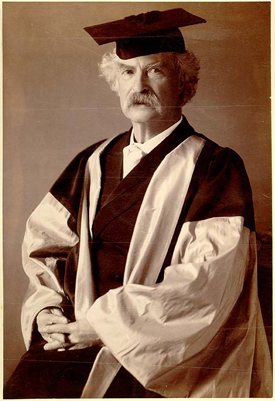
Woven through this drama are the fantastic lectures of Samuel Clemens. In the future, students will have nothing but the most exciting, engaging, and informative professors. We've all had amazingly inspiring teachers but also think of the dull ones: the ones that mumbled, yawned, or trailed off into empty confused space, blankly staring back at their audience of students. With MOOCs everyone will be taught by Samuel Clemens. Just as he regaled audiences around the world with stories of adventure and love, dynamic professors like Ann Swindler and Harold Scheubwill turn tedious degree requirements into something exciting, engaging, and memorable. University education will be as entertaining as it is informative. Students will have not just a few memorable professors but rather four consistent years of intellectual challenge, adventure, and stimulation. Graduates will emerge with minds polished sharp and appetites expecting the best. Why shouldn’t universities be as good as multiple seasons of Mad Men? Perhaps they will be…
However, the specter of Detroit and other post-industrial cities looms just out sight, haunting these dreams. Walking around campus at the University of Wisconsin-Madison the place would seem to last forever. Grand and bland buildings alike bustle with life, looking impenetrable to change. Construction never stops and thousands of eager applicants are rejected each year. And yet, I imagine this same assurance was felt by workers in Detroit, Cleveland, and Milwaukee during the 1950s and 60s. On their evenings off from Pittsburgh steel plants, my grandparents drove new cars around a dynamic city, stopping here to eat an ice cream or there to dance the jitterbug. On weekends, they strolled down crowded Braddock Avenue for Catholic mass and later Sunday brunch. All of this is gone of course. Much of Pittsburgh, like Detroit, is a wasteland. Braddock Avenue is an icon of post-industrial America, its crumbled buildings photographed as ruin porn. My grandparents’ cathedralsnow have collapsed roofs, and the mansions of the elite lean on dilapidated foundations, smiling back with broken windows.
Will lecture halls, our hallowed cathedrals of learning, sit dormant, fade, and eventually crumble to the ground? Of course they will. Why should a thousand different sociology professors teach Introduction to Sociologyevery fall when the best professors from Berkeley, Princeton, Yale and UNC-Chapel Hill could take turns teaching to the entire country?
Will universities become internet-photo-curiosities, idle distractions from work-a-day routines? It’s quite possible. As undergrads, friends and I explored abandoned amusement parks along the Jersey shore, photographing roller coasters and conjuring various ghosts creeping through fun-homes and tunnels-of-love. You may have explored other ruins, forgotten castles or asylums perhaps. It’s easy to imagine wealthy young people doing the same years from now, walking around abandoned campuses with overgrown grass and broken windows. They will photograph the collapsed arches of our lecture halls and wonder what it was like to sit for an hour in those hard wooden chairs. They’ll do their best to envision crowds of students rushing to class.

Like any good historical drama, this dream’s actors are vividly human, their efforts creative and disturbing. Such a future is exciting and beautiful, but it is also tinged with tragedy. Poised as we are on the brink of a new future, you can almost see Samuel Clemens watching us in white with a bushy mustache, smirking, “Never let the campus get in the way of your education.”
Thursday, July 11, 2013
Time to Make College Loans Dischargeable
This post has been revised following excellent additional information provided by Zakiya Smith of the Lumina Foundation and Rachel Fishman of the New America Foundation. Thanks!
Student debt is the worst possible form of debt in one critical way: it almost never leaves you. You may be disabled, unemployed, or even dead, but you almost always still have to pay.
This "non-dischargeable"status is said to exist because there is no way to repossess the assets (your education) to pay off the creditors. But that cannot be the only reason for this extreme rule. Instead, it's another example of putting bankers' needs above those of the average American.
Federal student loans technically can be discharged (while private loans cannot-ever) but it's a very difficult process and almost no one does it. Among those seeking a discharge, about 40% are granted, but only 0.1% of student loan debtors filing for bankruptcy have sought to discharge their loans. Those who do file and succeed are often poor, unemployed, and having medical problems. It used to be the case that loans were much more readily dischargeable. All student loans could be discharged in bankruptcy until 1976. Student loans could be discharged after a waiting period (of initially five and later seven years after repayment was scheduled to begin) until 1998. Federal student loans became nondischargeable in bankruptcy in 1998. Private student loans became nondischargeable in bankruptcy in 2005. Why not work to once again make both private and federal loans (more) dischargeable?
The pros are obvious -- students drowning in debt could declare bankruptcy and get a fresh start. Certainly their credit would be ruined for a few years, but since many aren't trying to buy homes and it's increasingly the case that it doesn't hurt job prospects, this isn't the end of the world. In addition, lenders might make credit less available, and I tend to think that will help to drive down the costs in higher education (yes, I partly agree with the Bennett Hypothesis).
The cons are less clear, if we put aside the powerful interests of the financial industry . Would this give students incentive to go bankrupt? Recall that these are people who invested in postsecondary education and thus are actively trying to better their position in the world. They will not take bankruptcy likely, and those who treat it as anything less than a last resort will be a tiny minority (when bankruptcy was the same for student loans as all other loans, far less than 1% of federal loans were discharged this way). In fact, however, bankruptcy is critical in free market economies: it instills a sense of hope in the face of adversity. In other words, there are both conservative and liberal rationales to support this effort.
So if we are not doing this, we have to admit that it's because we aren't brave enough to strong enough to stand up to the lenders. An effort to make private student loans dischargeable again was introduced this year in the Fairness for Struggling Students Act and the Know Before You Owe Act and both failed.
Isn't it time for a change? Can't we mobilize more broadly to advance this right now by pursuing reform in the Senate judiciary committee?
Student debt is the worst possible form of debt in one critical way: it almost never leaves you. You may be disabled, unemployed, or even dead, but you almost always still have to pay.
This "non-dischargeable"status is said to exist because there is no way to repossess the assets (your education) to pay off the creditors. But that cannot be the only reason for this extreme rule. Instead, it's another example of putting bankers' needs above those of the average American.
Federal student loans technically can be discharged (while private loans cannot-ever) but it's a very difficult process and almost no one does it. Among those seeking a discharge, about 40% are granted, but only 0.1% of student loan debtors filing for bankruptcy have sought to discharge their loans. Those who do file and succeed are often poor, unemployed, and having medical problems. It used to be the case that loans were much more readily dischargeable. All student loans could be discharged in bankruptcy until 1976. Student loans could be discharged after a waiting period (of initially five and later seven years after repayment was scheduled to begin) until 1998. Federal student loans became nondischargeable in bankruptcy in 1998. Private student loans became nondischargeable in bankruptcy in 2005. Why not work to once again make both private and federal loans (more) dischargeable?
The pros are obvious -- students drowning in debt could declare bankruptcy and get a fresh start. Certainly their credit would be ruined for a few years, but since many aren't trying to buy homes and it's increasingly the case that it doesn't hurt job prospects, this isn't the end of the world. In addition, lenders might make credit less available, and I tend to think that will help to drive down the costs in higher education (yes, I partly agree with the Bennett Hypothesis).
The cons are less clear, if we put aside the powerful interests of the financial industry . Would this give students incentive to go bankrupt? Recall that these are people who invested in postsecondary education and thus are actively trying to better their position in the world. They will not take bankruptcy likely, and those who treat it as anything less than a last resort will be a tiny minority (when bankruptcy was the same for student loans as all other loans, far less than 1% of federal loans were discharged this way). In fact, however, bankruptcy is critical in free market economies: it instills a sense of hope in the face of adversity. In other words, there are both conservative and liberal rationales to support this effort.
So if we are not doing this, we have to admit that it's because we aren't brave enough to strong enough to stand up to the lenders. An effort to make private student loans dischargeable again was introduced this year in the Fairness for Struggling Students Act and the Know Before You Owe Act and both failed.
Isn't it time for a change? Can't we mobilize more broadly to advance this right now by pursuing reform in the Senate judiciary committee?
Monday, July 8, 2013
"Pay It Forward" or "Pay It Yourself?"
The evidence is clear: the current system of financing postsecondary education in America fails to match the desire of its people or the needs of this ambitious nation. Growing demand for the education and training that college provides has helped propel millions into public institutions providing postsecondary education, which history predicts would lead to calls for a greater role in the provision of that education. Yet as the fraction of adults enrolling in college has increased, college costs have been transferred from government to individuals. In particular, many state governments have decreased per-student appropriations, slashed the fraction of tax revenue devoted to financing higher education, and done little to contain costs at public institutions. These moves put today’s students and many future generations at risk of significant debt that could compromise their investments in family, education, and work. In true “perfect storm” fashion, this transfer of responsibility has accelerated as educational requirements for stable employment continue to rise, and real family income slides downward.
It is therefore unsurprising that in some states, politically active members of the both the working and middle-classes are objecting to the most visible evidence of this crisis: the ever-increasing amount of student debt. That debt is accrued even after many families pay out-of-pocket for a substantial portion of college costs, not to mention tax payments that go to state appropriations. Coupled with a weak labor market in which employment for bachelor’s degree recipients is slacker in some fields than people might have anticipated, the legitimacy of the current financing system for higher education is being called into question.
While many state legislatures are taking very incremental actions toward change, in a few places political action has been more dramatic. Most recently, in Oregon the legislature rapidly passed a bill called Pay It Forward (HB 3472) that aims to “provide access for all Oregonians to a debt-free degree and protect funding for public higher education. Specifically, the bill directs the Higher Education Coordinating Committee to examine and implement a Pay It Forward pilot program and a tuition freeze.” Pay It Forward is an income-based repayment plan (or what some call a “human capital contract”) modeled on similar efforts in Washington State and California that waives upfront tuition costs for students, instead requiring students to pay up to 3 percent of their income for 24 years to the state (0.75 percent for each year of college attended). Its authors, who include a long-time progressive activist and numerous students intimately acquainted with the near-impossibility of financing college today, are remarkable people who should be thanked for trying to change the status quo.
But the news coverage of the well-intentioned bill has dramatically overstated its promise, while also revealing a substantial appetite among some constituencies for rapid solutions to these pressing problems. Newspapers across the nation—including the New York Timesand the Wall Street Journal—have given it much attention, and Twitter is bubbling with kudos for the state and its advocacy community. Yet, for many reasons, I think that this bill will fail to live up to the high hopes of people advocating for it, and in the meantime mollify and distract reformers from the hard work involved in finding a lasting solution. Thus, even though I think that it is critical to find ways to make college truly affordable for all Americans, I cannot support Pay It Forward:
- It is probably not feasible. The two most difficult challenges it raises are how to fund the transition costs and how to collect the levy on students’ payroll. While proponents in Oregon suggest that the $9 billion needed to start the program could be raised through state bonds, they require voter approval and of course also must be repaid. Moreover once the money is distributed, the state must ensure that students repay. This will require active participation of the Internal Revenue Service (read: highly unlikely) or substantial work on the part of the state.
- It may reduce student debt slightly, but will not eliminate it. This “debt-free” plan only addresses tuition and fees, which amount to about 40 percent of the costs of attendance in public higher education. Students often borrow to cover the remaining costs (room and board, books, supplies, etc.) or have them covered by grant funds. While Pell recipients might be able to forgo borrowing under this new plan, it is very unlikely that other students will. Moreover, the plan is for students receiving up to four years of schooling, yet barely 50 percent of Oregon students complete a four-year degree in six years. Thus, it is highly likely that many if not most students will leave college with loans in addition to this repayment obligation.
- It has the potential to exacerbate class-based institutional segregation. A similar effort pursued at Yale in the 1970s revealed that wealthy students who achieve high-paying jobs do not like income-based repayment schemes. It is unlikely that times have changed, and wealth-seeking students will have an incentive to move from flagship public universities over to the private sector. If this is addressed by instead, allowing students to opt out and pay tuition and fees up front, the plan will become much more costly.
These are flaws in the plan’s construction that impede its workability and effectiveness. But the most important reason to reject Pay It Forward is that the plan’s approach distracts from the pursuit of a more effective solution that could benefit all Americans—not just those living in Oregon—and helps to fuel an insurgent mantra among critics of higher education who claim we are over-invested: “Pay It Yourself.”
Student debt today is high because colleges—both private and public—are charging students for non-academic activities, catering to the small number of families who desire an elite social experience for their children. States have not matched massive federal investments in student financial aid, instead capitalizing on an apparent willingness among public higher education institutions to transfer their share to students. In other words, both schools (public, private, and for-profit) and state legislatures are complicit in today’s crisis,and their impulses are not curtailed with Pay It Forward. Instead, the rhetoric of a “debt-free” public higher education serves to satisfy the left, mute the outcries, and distract public attention from an apparently popular desire to broaden access to postsecondary education by making it truly public.
The Claims That Pay It Forward Provides “Free” Public Higher Education
Before getting into the details of the Oregon bill, let’s review what the policy framing by the popular press might lead the public to believe it can accomplish.
- Pay It Forward brings “tuition-free higher education,” at least according to Fox News.
- Pay it Forward provides “free higher education the right way” according to Matt Bruenig at the American Prospect, the distinctly other end of the political spectrum.
What is most important about these statements is that while neither is factually accurate, both suggest interest in having more discussion about new ways to bring higher education to more Americans at a lower price. That’s exciting, and the search for good ideas is a worthwhile one.
At the same time, it is critical that policy proposals—if they are to be taken seriously—thoughtfully address both the pragmatic details involved and the full range of possible consequences. Unfortunately, the information put forth to date by the plan’s proponents is short on details and provide little sense of the potential unintended consequences. Given that, it is remarkable (and telling) how rapidly they have been advanced and accepted.
According to the bill passed by the legislature, Pay It Forward students would forgo paying tuition up front, and instead would pay—regardless of whether or not they graduate—a specific percentage of their earnings (depending on how many years they attended school) to the state for 24 years. It is clear that the total amount that most students would pay is greater than if they had paid tuition and fees up front—presumably a pact that many students might be willing to make, in exchange for the lowered payment amounts and longer payment period (a somewhat similar situation to 30-year fixed mortgages versus shorter-term adjustable ones). The plan is similar to a financing arrangement used in at least six countries, including Australia.
In other words, Pay It Forward is not “tuition free”—it simply changes the timing of tuition payments and creates more differentiation in how much tuition individual students pay. Nor does Pay It Forward offer “free higher education,” since not only must students pay the costs of tuition and fees later, but the costs of room and board, books, and other expenses (amounting to 60 percent of the typical college bill) are not covered at all.
The Status Quo: Tuition and Fees Are Only a Fraction of Costs
Many Americans might have done a double-take at the last sentence. Yes, tuition and fees constitute the minority fraction of the costs of attendance at public universities. Take the University of Oregon, for example.
Tuition and Fees = $9,830
Room and Board = $10,722
Books and supplies = $1,050
Other expenses = $2,430
TOTAL Cost of Attendance= $24,075
Reasonable people might disagree over who should cover the costs of room and board for college students, but the fact remains that they must be covered primarily through sourcesother than work if the average student is to succeed in completing a degree. Undergraduates rarely secure jobs paying more than minimum wage, and if they are to have time to devote to studying, they should not work more than 20 hours a week—and for those with weaker academic skills in need of tutoring, far less. For students in today’s economically vulnerable families, who depend more heavily on one another for support, time for working is increasingly crowded out by the need to care for both older and younger family members. And summer work is not a likely option, since many students need to take classes in order to get hard-to-access courses completed, retake failed courses, or complete enough credits to finish in four years.
So, given all of those stipulations, let’s assume an undergraduate is willing and able to work 20 hours a week at minimum wage. After taxes, the student will earn just under $7,000 a year. Even with payment of tuition and fees delayed until after graduation, their wages would only cover about half of their costs of attendance. The other $7,000 remains: if Pell-eligible, the student may have that covered with federal aid, but if not, the family either pays it or borrows it. That’s right: under Pay It Forward, the average student will still need to work 20 hours a week and pay about $28,000 (somehow) in order to get a bachelor’s degree—after which, up to 3 percent (maybe more) of annual income will be taken by the state for a period of 24 years.
Is this worse than the status quo? Maybe, depending on who you are and what the actual percentage ends up being (more on that in the next section). A few facts regarding the policy’s intended resolution of student debt are necessary to understand why it will not significantly improve the current situation:
- The crisis in student debt is not mainly in the public sector. The $1 trillion in total debt resides mainly with two groups of students: poor students attending for-profit universities, and those engaged in a long period of education, including graduate school. Neither of these are addressed by Pay It Forward.
- A federal, income-based repayment (IBR) option already exists and is underutilized. There are two main issues confronting students in public universities with debt. First, large numbers do not finish their degrees, making repayment much harder. Second, those who graduate do not opt for the existing income-based repayment plan, instead paying substantial amounts of their income over a short period of time, even when unemployed. This puts them at risk for delinquency or default. But there is already a solution: the federal IBR option, which prevents delinquency or default entirely by making monthly payments conditional on income and capping payments at no more than 15 percent of income. The repayment period is often far shorter than Pay It Forward’s, but only a small fraction of borrowers has enrolled in IBR, seemingly because many do not know about it. Presumably IBR would continue to exist under Pay It Forward and payments for the Oregon program would not be counted as debt (since it is not called a loan). In this case, students would be enrolled in two “affordable” repayment plans but have to make debt service payments approaching or in excess of what either program considers “affordable.”
- Private providers already offer very similar options to students. There are at least two firms in the private sector that make these investments in students, but instead of putting taxpayers on the hook for the risk that students will not repay, investors can choose to invest or not invest in a given student based on their comfort with the likelihood that the student is a good risk. These firms use variable-rate rather than flat-rate risk pricing to protect that investment. It is not clear that a flat-rate scheme is better for the majority of students, or good for the state, and I strongly suspect the rate will therefore climb substantially over time as problems with the initial calculations are realized. Consider whether you would support this plan if the amount that must be repaid were 5 percent, 10 percent, or even higher? With this option already available to students yet not remotely popular, why should the state get involved?
- Parents of students in the public sector often hold more debt than their students. The amount students can borrow each year is capped such that middle-income students rarely borrow more than $5,000 a year. But parents face fewer restrictions, opting for the Parent Plus Loan and private options, financing up to $15,000 or more a year. The real crisis may lie with parents affected by debt accrued for their children—and if anything, Pay It Forward may most suit their needs by passing more costs to their children.
The truth is that, despite lofty promises, Pay It Forward has the potential to do very little if anything about the significant burdens facing higher education’s key stakeholders.
The Burden on the State
Income-based repayment programs are difficult to particularly implement for two reasons. First, they require a great deal of upfront cash. You cannot loan out money you do not have. Reports indicate that Oregon must raise at least $9 billion to get this program started, and yet the proposals provide no indication of where it might come from. I am told that the likelihood source is state bonds, which of course require repayment as well. Perhaps even more importantly, $9 billion is very likely a significant underestimate of the actual costs. One key issue is that only about half of entering undergraduates in Oregon public universities turn into graduates over a six-year period—so it repayment will be slower to accrue and likely lower than anticipated. In addition, the projected earnings trajectories by age on which the repayment calculations are made need to reflect the demographic at hand—they are based on averages yet the majority of today’s graduates are women, and they continue to earn less and take more time off from employment for childbearing. The less that graduates pay back, the more the program costs up front. Moreover, I doubt that students will tolerate such a lengthy repayment period, and if it is shortened, the costs go up. Thus, if $9 billion is an estimate based on high four-year graduation rates, uses average earnings rather than for a predominately female group of students, and assumes a maximum of 3 percent then it is substantially under-stated.
Sometimes the best intentions go awry, and in this case it is possible that instead of state bonds, the Oregon Legislature could opt for a funding source mentioned by advocates in Washington State: ending need-based financial aid in the form of grants to low-income students. The consequence? Students from low-income families would have to pay even more for their own education. That’s one way of leveling the playing field, but not one that many progressives would support.
Second, there must be a mechanism for collecting the money loaned to students. This is an enormous undertaking, and one far harder to accomplish as an individual state or in a nation as large as the United States. (Australia—one country where a similar plan is in effect—is not a reasonable example in this case.) The challenge of recollection is not a hypothetical, and it is not a small or inexpensive concern; in fact, an American example suggests that the wealthiest students will be the ones most likely to try and abdicate on repayment. In the 1970s, Yale University instituted a Tuition Postponement Option, developed by Nobel prize–winning economist James Tobin, designed to “help needy students afford an Ivy League education in a way that wouldn’t discourage them from pursuing worthy low-paying careers.” Similar to Pay It Forward in concept, it effectively backfired, as students who did well with their Yale education refused to repay, and bad-mouthed the program. Incredibly, beneficiaries publicly denigrated it as a terrible financial tool, and drew parallels between its longevity and the lasting power of some sexually transmitted diseases! We can expect today’s wealthy alumni to do the same, and demand an opt-out mechanism, which will undermine the program’s financial stability if granted.
Certainly, the participation of the Internal Revenue Service would greatly help this effort, but gaining that participation is no small feat—and the IRS will have a substantial burden to carry.
The Burden on Students
Let’s say the proposal is funded and moves forward. What next? In terms of consequences for students, the biggest change is that tuition and fees will be paid post-graduation (or post-dropout, since despite media reports, all students will pay, not only graduates) and the amount paid will depend on one’s income over the next 24 years. There are several possible positive benefits, including: reducing fears of sticker price among some students, allowing families to save for a longer period of time to pay college costs, lessening student debt, and creating an incentive for students to opt for less lucrative fields for their jobs and careers or stay home to raise kids.
But these potential benefits are overwhelmingly hypothetical. Colleges and universities will still have to disclose the remaining cost of attendance, which will be substantial, so sticker shock will remain. As noted earlier, most students will still have to borrow money to pay those costs, or families will have to pay them out of pocket. Rather than saving for future tuition payments, trends in family dynamics suggest that parents are just as likely to reduce their obligation to contribute to their children, since once they are employed they are “on their own” as adults. In this case, the share of college costs paid by parents rather than children may decline. In fact, this seems to be an intention of the plan, as it proponents are careful to highlight the rising amount of student debt held by parents. Finally, there is little evidence that income-based repayment plans succeed at changing occupational choices—they provide a reward to people who opt for socially valuable but less lucrative careers, but do not induce them to choose them over other options.
In addition, many middle-class students who currently pay for college at least partly out of pocket may pay a larger sum of money for their tuition and fees under the plan than they do currently. A graphic in the Wall Street Journal makes this clear: while median debt among borrowers hovers around $25,000, the average student paying it forward will pay an extra $7,400 for the longer repayment period. (Moreover, these numbers are likely understated since they do not adjust for net present value.) For students with currently lower-than-average debt loads and higher than-average earnings, the costs will be higher. The real beneficiaries might be those students borrowing more than the average amount to attend college while earning less than average post-graduation—but this hinges on their ability to cover their costs of attendance outside of tuition and fees without borrowing. If they borrow, the apparent benefits of this plan will be diminished. And if the repayment percentage rises, and it easily could, this calculus adjusts yet again.
Pay It Forward’s Trojan Horse
Oregon is getting a remarkable amount of praise for this plan, and undoubtedly its legislators are thrilled. The plan calls for the state to continue to invest in public higher education going forward, the part of the deal that is arguably most critical. But the real “pay it forward” in the plan is the goal that today’s students will create a “stable funding stream” for tomorrow’s students—relieving the state of the need to do so. Critically, the plan’s authors call it a plan of “shared responsibility.” Given that they are students, it is likely that they mean to imply that the state will do more to participate—but the state in this case may forecast the opposite—a willingness of students to do even more to pay for college themselves.
After all, Oregon has taken steps in recent years towards the privatization of public higher education. The share of general fund monies going to higher education in Oregondeclined from 17 percent in 1997 to 5.8 percent in 2009. It is a laggard, falling in the bottom 20 percent of appropriations per FTE. Moreover, Republicans have endeavored to exert less direct financial oversight and administration of public universities in the state by altering the governance structure, which could lead to further cost escalation. But this isn’t unusual these days, as most states seek to justify their disinvestment in higher education and seek ways to take it further. What better evidence that the state could get away with doing even less for students than observing those same students agreeing to cover the costs themselves, out of their future income?
Lest this sound overly cynical, consider the case of Virginia, where the flagship university argued that by doing more itself, state support would increase. In fact, the more financial independence the university took on, the less support it got—students and families pay a larger fraction of college costs in the state than ever before.
The key here is that the Oregon plan requires students to pay their future income back to the state for decades to come—but does not obligate the state to continue its investment. This is unsurprising, since from their inception by economist Milton Friedman these “human capital contracts” have treated higher education as a private good. While the state may not raise the repayment percentage paid by current students, it can certainly increase it for future students—and it will have every incentive to, as long as public objections remain relatively quiet.
In other words, there is a possible dark side of the proposal getting insufficient attention: some Oregon legislators seeking to spend less on higher education may be supporting Pay It Forward in order to simultaneously quell public outrage about student debt, garnering positive media attention and votes, while also increasing the fraction of higher education costs paid by students and families.
Reducing Educational Inequality, or Exacerbating It?
There rhetorical approach used to describe Pay It Forward is notable: it is “not a loan” but rather a “social insurance program.” Use of that social insurance will purportedly reduce barriers to college attainment and promote equality. How will this occur?
In fact, Pay It Forward seems most likely to benefit the parents of students from middle-income families who are currently taking on PLUS loans that are not subject to income-based repayment now. If they transfer their current financial contributions (before loans) to helping their students fund their other costs of attendance (most likely to help them avoid the need to work) and they do not offer to contribute to the payments post-college, then their own borrowing will lessen. But importantly, this will be achieved by transferring the burden to their children—not by getting rid of it entirely.
Even more importantly, however, the policy has the potential to increase the institutional segregation of students based on family income. Students from wealthy families at public institutions do not accrue much debt now—they pay out of pocket—and they could paymore under Pay It Forward. In fact, that is precisely the intention of the model: as one reporter described it, “Just like a venture-capital portfolio that earns its profit from a few star investments, many students would end up underpaying the cost of their college, subsidized by the school’s star businessmen.”
As illustration, consider that with annual tuition and fees of about $10,000 they currently pay about $40,000 in tuition and fees for a bachelor’s degree at public institutions. If they go on to average $80,000 per year over the next 20 years, they will have paid almost $48,000—and if they earn more, they will pay more. The value of paying that money out more slowly over time may convince them that it is worth remaining in public higher education, but it is just as likely that they will perceive a disincentive to stay in a system that capitalizes on their future earnings in this way, when private institutions offer them the easier option of having their parents pay now. If the students with the greatest earning power face incentives to leave the public sector (as suggested by the Australian experience) the long-term sustainability of Pay It Forward may also be in question. Worse yet, the model will likely allow wealthy families to ‘opt out,’ exacerbating the current situation in which some students graduate with no debt, and others pay off college for decades.
Admittedly, many of the concerns raised here are hypothetical ones. But this proposal is entirely hypothetical. The plan for a demonstration program is a weak one, since it would be impossible to extrapolate the findings from an experiment done with a few universities to implications for either a state-level or national policy, and it would be unethical and impossible to properly assess effects using methods like random assignment in order to get clear evidence of effectiveness.
The Political Consequences of Pay It Forward—Pay It Yourself
It may seem to the reader a bit odd for a scholar like myself, so concerned with finding ways to make college more affordable, to argue so strenuously against a seemingly progressive policy. Fully explaining my reason for engagement requires a brief discussion of the political economy of “Pay It Forward” plans.
For forty years, a quiet revolution has redefined individual value as residing in “human capital,” a commodity rather than part of an integrated society. As such, advocates of higher education have willingly embraced a narrative that says those who benefit shall pay. The effect of this model has been an increasing focus on the wage premiums accruing to college degrees, growing efforts to document individual-level returns across and among individuals rather than impacts on society, and the development of a student loan industry that makes it possible for colleges and universities to raise costs without losing enrollment.
We have lost sight of two critical things. First, there is a broad societal function of education: ensuring that our democracy has informed voters capable of full participation. A focus on that function means funding public postsecondary education through taxation, shared progressively across all citizens of a state. Furthermore, it means constraining those public institutions from developing elaborating university activities while enjoyable for participants, putting college beyond financial research for the general public. A focus on high-quality postsecondary learning with few extras, no frills, could be provided and publicly supported with a true social compact, one involving all key partners, including the federal government. Turning the energy around this proposal into a constructive plan that moves toward that goal would be a smart move.
In addition, institutional behaviors matter for the success of their students. Pay It Forward does nothing to address the numerous challenges created by the actions of colleges and universities, including those in the public sector, and even lets states off the hook for monitoring those behaviors. It is predictable but unfortunate that the proposal includes no accountability for either states or higher education institutions. In fact, their abdication of responsibility for college affordability over the last forty years is why we are in this mess in the first place.
Unfortunately—and I think unintentionally—Pay It Forward subscribes to the same old narratives and assumptions of the current system. Not only is it silent on the matter of college costs and taxation and does nothing to increase the government role in shouldering the burden of costs, but the solution it offers is for students to help themselves. As one of the student authors of the plan told the New York Times, “When we talked to legislators, conservatives said it appealed to them because it’s a contract between the student and the state, so they see it as a transaction, not as a grant.” That’s partly right—it is a transaction, one that requires repayment, and most certainly is not a grant. But it is also not a two-way contract between students and the state, it is one-way, and largely student to student. Instead of Pay It Forward, it might be called Pay It Yourself.
The short-term benefits of the plan could be undermined by the longer-term political consequence of silencing the fire raging among those seeking a real long-term solution. It is very unlikely that Pay It Forward will be financially possible, initially or over the long haul, but it is quite likely that popular appetite for the program will satisfice enough people to keep them from working day and night on better solutions.
In other words, my largest concern is that neutering the powerful voices of middle-class families outraged about skyrocketing debt and high tuition with a Pay It Forward approach is politically convenient and could unintentionally cripple real progress toward real solutions. It conveniently skirts issue of high college costs by emphasizing the flexible, long-term nature of the repayment plan, and obscures discussions of rising tuition entirely. In fact, college graduates will pay under this plan—and they will pay far too much. Today, investments in postsecondary education are not private transactions but rather are public ones, and the social insurance policy we need is one that combines truly free tuition and fees with need-based financial aid.
You can hear me discuss these issues further on National Public Radio's On Point program, which aired Wednesday July 10, 2013. The audio recording is here.
In addition, you might want to check out the following commentaries on the Oregon Plan.
Tuesday, February 19, 2013
Recruiting in Classrooms???
The Answer Sheetover at the Washington Post recently ran an editorial by a professor at Fordham University about his reasons for not allowing Teach for America to recruit in his college classroom. Mainly, he objects because TFA focuses on short-term rather than long-term commitments to teaching and as a result, he claims, “an organization which began by promoting idealism and educational equity has become, to all too many of its recruits, a vehicle for profiting from the misery of America’s poor.”
Like this professor, I don’t allow TFA to recruit in my classrooms at the University of Wisconsin-Madison. Apparently, many of my colleagues feel the same way. When I noted this on Twitter and Facebook, the response was substantial. Faculty from across the country said “me too,” “me too,” though only a few elaborated on why.
Those that did expound on their practices revealed that TFA’s strategy of in-classroom recruitment may have unintended consequences. The professors, it seems, use it as an opportunity to describe the “cult-like” aspects of the program, the negative experiences other students have had with it, and the ways it undermines a focus on high-quality teaching and teacher retention. No, this is apparently not limited to my colleagues in education or sociology; I heard similar stories in STEM disciplines too.
But regardless of whether the recruitment strategy employed by TFA works or not, and whether or not professors take kindly to it or not, my reason for not allowing TFA to recruit in my classroom is very simple: My classroom is a place for education not solicitation.
The bigger question neglected by the Washington Post editorial—and the one that should be asked all over the country— is why is any organization seeking to take class time for advertising? And why are universities allowing it? At most colleges and universities, solicitations are confined to public spaces. Why should this only apply to commercial solicitation? If TFA is allowed to recruit during our class time, then doesn’t any other potential employer have the right to? Do we professors really want to subject ourselves to fielding such requests? Even if no endorsement is implied—and I believe that we’re fooling ourselves if we don’t understand that it’s inherent in opening the door—it still costs us limited instructional time.
There is a hypocrisy in future educators asking current educators to take time away from their teaching so that they can “pitch” students on their product. Teach for America is just one potential opportunity after all; there are numerous others out there. Our job as professors is to help students develop the critical thinking skills needed to vet these options for themselves—not provide the time for advertisers to reach them.
Subscribe to:
Posts (Atom)