Showing posts with label MOOC. Show all posts

Tuesday, July 16, 2013

Will the Campuses Crumble? A Dream of the Future involving Detroit, Mad Men, and Samuel Clemens

This post is authored by R. Thomas, a graduate student at the University of Wisconsin-Madison.


There’s a lot of talk these days about university reform, and coursing through it I see a beautiful and tragic dream of the future.  Dreams, of course, meld idiosyncratic images and mine blends Detroit, Mad Men, and the great speeches of Samuel Clemens. 
We all know the story: Boosters of online education suggest that American higher education should rely upon a small group of superstar lecturers, computer-based grading systems and thousands of adjunct graders to deliver content to the masses. To benefit from economies of scale, some say we ought to have centralized national committees that decide what gets taught and who gets to teach it. Advocates claim online education will cut costs, improve educational outcomes, and bring higher education to underserved populations.

Such efforts carry the excitement of novels for me. As in Mad Men, the details of work and visions of the future are riddled with action and curiosity.  Much of the drama, of course, comes in waiting to see what will happen. Will we break social hierarchies, educate every American, and revitalize a lagging economy?  On the job front, will employers readily hire people with online degrees?  Will we create an exceptionally creative and dynamic economy with online education or add to the legions of overeducated and underemployed young people? And what will happen to the humanities, challenged as they are to bring engaging discussion online? Will they be too expensive to deliver and thus rendered irrelevant?   Finally, how will professors respond to these online reform efforts? Some Harvardprofessors have pushed back against EdX, but will they succeed? 

Of course, as in Mad Men, many of the characters are compelling and hard to ignore. Most players pursue admirable aims, while a few see profit at every turn. Technical wizards test the boundaries of possibility on a daily basis. Finally, for intrigue, we have one prominent voice whose book describes his genius and 6’8” stature as well as his passion for greater access.  And don’t forget the eminent MOOC professorwho aped Wal-Mart management when asked to address his responsibility to the academic community. Finally, I’m sure if we looked hard enough, we'd find plenty of romance.
 
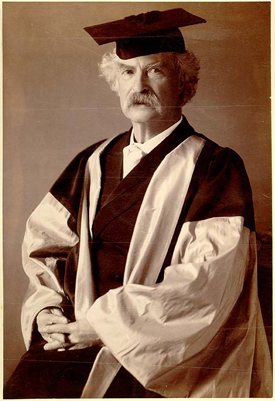
Woven through this drama are the fantastic lectures of Samuel Clemens. In the future, students will have nothing but the most exciting, engaging, and informative professors. We've all had amazingly inspiring teachers but also think of the dull ones: the ones that mumbled, yawned, or trailed off into empty confused space, blankly staring back at their audience of students. With MOOCs everyone will be taught by Samuel Clemens. Just as he regaled audiences around the world with stories of adventure and love, dynamic professors like Ann Swindler and Harold Scheubwill turn tedious degree requirements into something exciting, engaging, and memorable.  University education will be as entertaining as it is informative. Students will have not just a few memorable professors but rather four consistent years of intellectual challenge, adventure, and stimulation. Graduates will emerge with minds polished sharp and appetites expecting the best. Why shouldn’t universities be as good as multiple seasons of Mad Men?  Perhaps they will be…

However, the specter of Detroit and other post-industrial cities looms just out sight, haunting these dreams.  Walking around campus at the University of Wisconsin-Madison the place would seem to last forever. Grand and bland buildings alike bustle with life, looking impenetrable to change. Construction never stops and thousands of eager applicants are rejected each year. And yet, I imagine this same assurance was felt by workers in Detroit, Cleveland, and Milwaukee during the 1950s and 60s. On their evenings off from Pittsburgh steel plants, my grandparents drove new cars around a dynamic city, stopping here to eat an ice cream or there to dance the jitterbug.  On weekends, they strolled down crowded Braddock Avenue for Catholic mass and later Sunday brunch. All of this is gone of course. Much of Pittsburgh, like Detroit, is a wasteland. Braddock Avenue is an icon of post-industrial America, its crumbled buildings photographed as ruin porn. My grandparents’ cathedralsnow have collapsed roofs, and the mansions of the elite lean on dilapidated foundations, smiling back with broken windows. 

Will lecture halls, our hallowed cathedrals of learning, sit dormant, fade, and eventually crumble to the ground? Of course they will.  Why should a thousand different sociology professors teach Introduction to Sociologyevery fall when the best professors from Berkeley, Princeton, Yale and UNC-Chapel Hill could take turns teaching to the entire country?

Will universities become internet-photo-curiosities, idle distractions from work-a-day routines? It’s quite possible.  As undergrads, friends and I explored abandoned amusement parks along the Jersey shore, photographing roller coasters and conjuring various ghosts creeping through fun-homes and tunnels-of-love.  You may have explored other ruins, forgotten castles or asylums perhaps.  It’s easy to imagine wealthy young people doing the same years from now, walking around abandoned campuses with overgrown grass and broken windows.  They will photograph the collapsed arches of our lecture halls and wonder what it was like to sit for an hour in those hard wooden chairs.  They’ll do their best to envision crowds of students rushing to class. 

Like any good historical drama, this dream’s actors are vividly human, their efforts creative and disturbing. Such a future is exciting and beautiful, but it is also tinged with tragedy. Poised as we are on the brink of a new future, you can almost see Samuel Clemens watching us in white with a bushy mustache, smirking, “Never let the campus get in the way of your education.”

Saturday, March 2, 2013

The MOOC Industrial Complex

These days, every education reform movement seems to generate profit for multiple partners.  Take No Child Left Behind, the latest testing and accountability regime. As many scholars have documented, billions of dollars have flowed to corporations providing the tests, textbooks and "supplementary education services" required by that federal policy.  Advocates say this is appropriate since it means the market is functioning freely to provide high quality services, while critics note that absent government regulation (carefully limited under the law) public goods are quickly becoming private ones.

In recent blogs about MOOCs, I questioned their business model, asking why supposedly cash-strapped universities (like mine) would choose to engage with them when there is no evident monetary return?  I received little response from MOOC advocates on that question. But the answer is becoming increasingly clear.

Many universities have stated that MOOCs are the kind of innovative activity that donors would like to support, and that we would gain new donors if we engaged in creating them.  University foundations, including UW-Madison's, seem quite confident in this-- to the point that they are putting in their own dollars for the initial investments to get MOOCs off the ground.  While it's possible that this is sheer altruism, it's doubtful-- their leaders always expect a return on investment.

Where will it come from?

Why, the industry that supports the MOOCs of course.  For example, today's New York Times  documents the growing testing industry associated with online proctoring, helping colleges "keep an eye" on online test-takers. Unfortunately that article failed to investigate the money involved in this effort, focusing instead on the quality of the services provided to prevent cheating. This is unfortunate, since tracking the dollars created by the work of educators, ultimately benefiting the corporate bottom line is exactly what the "paper of record" should be doing.

What other entities will benefit from the instructional activities provided by public and non-profit universities?  Write in and let's start a list.  And while we're at it, let's think hard about the likelihood that these corporations will eventually constitute those "benevolent new donors" our universities are counting on.


ps. I keep meaning to direct my readers to this excellent commentary in the Chronicle of Higher Education. I highly recommend reading it in full.

Thursday, February 21, 2013

Predatory Privatization: Exploiting Economic Woes to "Transform" Higher Education

Milton Friedman must be dancing in his grave at the moment.  In every economic crisis there's an opportunity to impose change, he professed, and no smart leader let such an opportunity pass by. Especially when it comes to undermining public goods.

Leaders of MOOC movements across the nation, including here at home in UW-Madison, are telling us that this is simply the right time to take the leap into a transformed space in higher education, one enabled by technology.  I have absolutely no doubt that they sincerely believe this.  And I have equally little doubt that most are entirely unaware of their place in history, and the degree to which they are acting out a narrative written many decades earlier.

MOOCs are not primarily or even secondarily about bringing open, no-cost education to the masses. Instead, these efforts created by private elite institutions and for-profit businesses squarely aim to outsource traditional governmental functions in education, and divert taxpayer dollars from the building of public assets and institutions to create long-term revenue streams and profit for corporations.  That's privatization, period.

If MOOCs were simply the meeting of technological triumphs and the demand of students around the world, they would have been embraced in a very different way, and developed in a much more democratic manner.  There is a third factor guiding their growth, and it reveals their true meaning.  As described in this document circulated by the "Committee on Institutional Cooperation," a consortium of the Big Ten universities plus the University of Chicago, it is the meeting of these two pressures plus economic pressures regarding debt and tuition that make this the moment for MOOCs.   Not only does traditional higher education face additional threats from regulation, say the leaders of MOOCs, but heck, you're fast becoming "irrelevant" too. Through disruptions from all over, we will be squeezed into submission.


Very little good has ever come from decisions made through austerity politics.

*****

Do you feel tired when hearing the word "innovation" because it's been so often in the news? Are you now just waiting for your university to do something about it? Did it ever occur to you that this is due to a coordinated push by business-minded authors and foundations to deliver the compelling message that "traditional higher education" is outdated because...

  • Uncontrolled cost increases
  • Graduates lack critical skills
  • Resistance to pedagogical innovation
  • Irrelevant scholarship
  • Tenure protects faculty from accountability
  • Undergraduate tuition is subsidizing  faculty research
  • Traditional universities are captive to the  prestige arms race—real change will  come from radical, low cost models

What's coming next? The Executive Advisory Board has a glimpse of the future for faculty...


After being shown by "innovators" that our beliefs are "traditional' and "outdated" we will next begin the pathway to salvation-- the 'gamification of education.'


The pathway is so clear, the future so bright, that there will be, according to this model-- "NO EXCUSES" for resisting transformation.  We will enter the new world of 'high capacity' instruction, which focuses on new hires-- not those old "experienced" teachers.

Recall the claims in New Orleans, when school reformers arrived, that "teacher experience" was overrated?

Sound far-fetched? Why would anyone bother to push this agenda so hard?  Oh, wait for it-- because the new education is entirely in service of the business sector.  'Cause of course, this transformation is all about the improving the economy, stupid!


Forget Liberal Arts, folks, now we will have Liberal Arts 2.0!


And for all of you researchers, no more need for "disciplines"- according to the report, those are going the way of the typewriter.

Finally, glory glory hallelujah we will reach the punchline:  more dollars reaching the private sector.


Scared yet? Wait for it...


Don't you see how inevitable it is? Stop clicking your heels together, Dorothy.. after all...


So, what to look for next?  PRIVATE rather than PUBLIC votes.  "Paperless" budgeting. And oh, so much more...


Still feel like sitting still and letting others make decisions for you, you "traditionalists? "


Postscript:
Some readers have suggested this blog is insightful while others claim it's a conspiracy theory. For both groups, I suggest you take a look at this new piece by Andrew Leonard.  Leonard, a journalist, began as roundly skeptical of claims like mine, but has evolved his thinking.  In this piece, he writes "But what if MOOCs actually turned out to be part of a right-wing plot? After some reflection, it’s become clear to me that there is a crucial difference in how the Internet’s remaking of higher education is qualitatively different than what we’ve seen with recorded music and newspapers. There’s a political context to the transformation. Higher education is in crisis because costs are rising at the same time that public funding support is falling. That decline in public support is no accident. Conservatives don’t like big government and they don’t like taxes, and increasingly, they don’t even like the entire way that the humanities are taught in the United States.It’s absolutely no accident that in Texas, Florida and Wisconsin, three of the most conservative governors in the country are leading the push to incorporate MOOCs in university curricula. And it seems well worth asking whether the apostles of disruption who have been warning academics that everything is about to change have paid enough attention to how the intersection of politics and MOOCs is affecting the speed and intensity of that change. Imagine if Napster had had the backing of the Heritage Foundation and House Republicans? It’s hard enough to survive chaotic disruption when it is a pure consequence of technological change. But when technological change suits the purposes of enemies looking to put a knife in your back, it’s almost impossible."

Exactly.