Showing posts with label college. Show all posts

Tuesday, August 20, 2013

Research Update: Unmarried Parents in College

In 2010, UW-Madison graduate student Kia Sorensen and I published a paper in the Future of Children about college access and success among single parents attending college. We utilized data from the 2008 National Postsecondary Student Aid Study (NPSAS) and the latest NPSAS just came out for 2012.

I notice the following trends related to this population. 
  1. The representation of single parents among undergraduates grew again. In the 1980s it was 7% and by 2008 it was 13%-- in 2012 it was 15.2%.
  2. That growth was entirely among women, not men.  The fraction of male undergraduates were are single parents remained steady at 8%, while the fraction of female undergraduates who are single parents grew from 17% in 2088 to 20.7% in 2012.
  3. The racial/ethnic differences in single parenting changed slightly, creeping upwards by a point for non-Hispanic white students and down a point for Asian students.
The situation for single parents on college campuses nationwide has not improved much over the last several years.  The Institute for Women's Policy Research is doing important work in this area and it's worth reading up on.  We need to be concerned about the supports provided to these parents, given how much is riding on their success.  In this latest data release, I'm  most troubled by the indication that rates of borrowing large amounts of money for college are much higher for single parents than for other students.   College has inter-generational benefits, and institutions need to be equipped to ensure they assist in that transfer.


Wednesday, August 14, 2013

Are Students Really Academically Adrift? Rethinking the Assessment of “Limited Learning” on College Campuses

Four years ago I attended a presentation at the annual meetings of the American Sociological Association (ASA) in which Richard Arum and Josipa Roksa previewed the findings of Academically Adrift, their influential book published in 2010.  In a column for the Chronicle of Higher Education, I wrotethat this “cool study” was producing some interesting results.  Most importantly, I reported, that it seemed like the learning gains identified by the research “didn’t look like much.”  I was concerned, for sure, and thus wasn’t surprised when the authors eventually subtitled their book “Limited Learning on College Campuses.”

 Fast forward, and after attending a presentation at this year’s ASA in New York last week, I’ve come to question my assessment—and theirs.   At the time, I was looking at percentage point gains over time, and we know that these are not a good way to assess effect sizes since they do not take into account the amount of variation in the sample. Once the gains are standardized, Arum and Roksa find that students tested twice, four years apart, improve their scores on the Collegiate Learning Assessment by an average of 0.46 standard deviations.  Now that’s a number we can begin to seriously consider.

Is a gain of 0.46 sd evidence of “limited learning” and something to sniff at?  As I said back in 2009, we need a frame of reference in order to assess this.   In the abstract, an effect size means little if anything at all.

For their part, the authors point to a review of research by Ernie Pascarella and Pat Terenzini indicating that on tests given at the time, students in the 1980s gained about 1 standard deviation.  Doesn’t that mean students learn less today than they once did, and that that’s a problem?  Actually, no.

Scores cannot simply be compared across different tests. The scales on tests differ and can only be linkedby administering the same test to comparable people. Clearly, the CLA was not administered to students attending college in the 1980s.  Nor, for that matter, were students then comparable in demographic characteristics to the students of today, or were the conditions of testing the same.

Certainly, the authors know this and it is why they seek to replicate their findings with different tests and samples.  There is some evidence that the effect size of about 0.44-0.47 holds up.  But the purpose of the replication, their main focus, is on whether the magnitude of the gains are the same—they are not using replication to think about whether the effect size is large or small.

So, let’s go back to that critical question.  It was during Josipa Roksa’s ASA presentation last week that I felt we finally had a reasonable answer.  Her talk focused on inequality in learning, and she showed several achievement gaps.   This is one good way to benchmark an effect size and it’s commonly done in k-12.  When educational interventionists seek to examine the size of a program’s impact on achievement, they often compare it to the magnitude of the black-white achievement gap in math, which is about one standard deviation.

The same exercise with the impact of 4-years of college on learning as measured by the CLA is illuminating.   The learning gap in parental education among first-year students in the Academically Adrift sample (e.g. the differences in CLA scores between students with a high school-educated parent and students whose parents completed graduate school) is 0.47 standard deviations.  The black-white gap is 0.79 standard deviations.  These are highly relevant comparisons, given that the posited benefits of colleges are thought to be especially strong and important for students facing more disadvantages.

Thus, the learning gains made during college are equivalent in size to the advantage that a student from an educationally-advantaged family holds over a first-generation student.  They are also almost two-thirds the size of the black/white gap.   In this sense, these are sizable gains. 

However, advantaged students make bigger gains during college such that the parental education gap is 0.54 standard deviations four years later.  This is entirely unsurprising, given the body of evidence indicating that colleges and universities are prioritizing the desires of elite students over the real educational needs of those for whom college is essential to social mobility.

Social inequalities are very hard to close—we won’t be reassigning children to new parents anytime soon. But four years of college clearly raises student achievement, and it is an intervention we can promote and can afford.  The findings from Academically Adrift tell a very different story than its subtitle suggests.  On average, college is transformative for learning, and the real tragedy is that higher education does not focus more attention on the neediest students in order to close the gaps that affect the stability and fabric of our everyday lives.


Monday, November 19, 2012

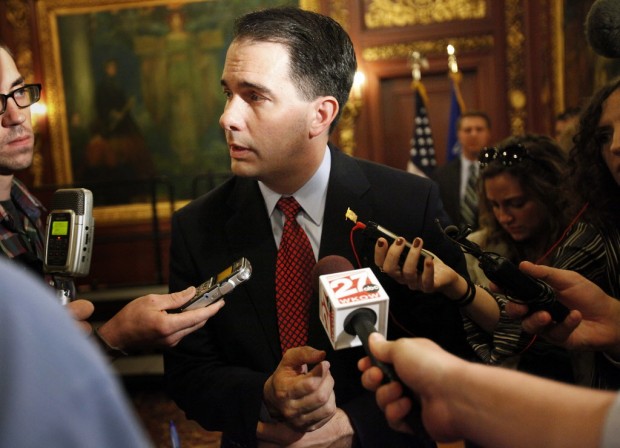
Scott Walker's Latest Agenda for Wisconsin Higher Education

With a headline like that, I bet you're assuming this is going to be one scathing post! The last time Scott Walker had ideas for Wisconsin public higher education, they involved separating UW-Madison from the rest of System. Or at least, so Biddy Martin told us.

This time, the issue is performance funding for higher education. Walker recently declared his interest in the model, and many people are naturally on the defensive. The common list of concerns is already being circulated (e.g. it will fail to distinguish between institutions with different missions and student bodies, intrude on institutional autonomy, and excuse cuts in regular state funding of higher education), but this is my favorite: Senate Minority Leader Chris Larson, a Democrat, said that Walker's plan sounds like "social engineering" that would force students to study "what industry wants" rather than what students want.

Ouch!  Sounds godawful.   But here's the thing-- this is not Walker's idea; it's an old, fairly passe idea, which he seems to have finally gotten around to reading about. (And by the way, most students simply want jobs-- which may be the same thing industry wants. Given the narrow k12 system we're putting them through, we can't be surprised at this outcome.)

The current higher education funding model is built on "butts in seats"-- the more students you enroll, the more money you get, up to a point. In this system, degree completion rates could be 25% or 90% and institutions would still get paid the same. If you believe graduation rates have anything to do with institutional effort, and there's some evidence that they do, this is a problem.  The policy shift from a focus on enrollment to a focus on completion occurred over the last 10 years, and has finally reached Wisconsin.

Is that a good thing? Not entirely. Is it a bad one? Not entirely either.  I've written about the problems with how higher education tends to ignore the college completion challenge; instead of accepting responsibility for completion rates, institutions tend to blame the students. If an 18-year-old freshman drops out of college, it's the student's "fault" but if a 17-year-old junior year in high school drops, it's either the parent or the teacher's "fault." This is an old model, from a time when college enrollment was fairly uncommon and clearly a "choice" rather than an economic necessity embraced by the vast majority of Americans as "required."  We have to catch up.

So let's try taking the focus on completion as a good thing -- AT LEAST FOR STUDENTS-- and worry instead about the devilish details that could screw it up. (Yes, this is a big assumption-- it's not clear the completion agenda is good for students, and it's obviously not always good for educators, but I have to start somewhere!)

(1) The focus on completion must not sacrifice the focus on enrollment.  Sound impossible? Only to educators. In fact, people in the job training realm have thought about this issue for years and managed to craft metrics that encourage programs to both open their doors and do a good job at providing training and access to high quality employment.  The key is crafting metrics to prevent creaming -- the phenomenon that occurs when a college says "Want us to jack the college completion rate? We'll just increase our admissions bar."   If the measure requires the institution to raise completion rater while not changing admissions standards, this can be prevented. Similarly, if you want the completion rates to rise while not locking out in-state students, that must be built in. One option is a variation on "risk-adjusted metrics" or "value-added" metrics though these are currently incredible flawed and should not be simply imported from national initiatives since they still largely fail to distinguish institutional characteristics (and missions) from student inputs (maybe because it's near-impossible given the strong feedback loop between the two).

(2) Process measures should be included to ensure quality is maintained. Colleges can raise graduation rates by simply reducing the number of credits required to graduate and/or making it easier to pass our courses. This isn't desirable, and close attention to these process measures will help. Tennessee and Washington State provide some examples, though I prefer Maryland's far more sophisticated model of reform.

(3) Completion alone is not enough. Coupling the graduation metric with assessments of both learning and job outcomes will help ensure the provision of a well-rounded education leading to both short-term employment and long-term job security. It doesn't help Wisconsin to have its colleges and universities turned into job-training shops that prepare people for the jobs of today -- as demanded by current employers.  We need to prepare people for the jobs of tomorrow and the days after that--we want them to get and keep jobs and have careers-- and research clearly demonstrates that critical thinking skills and the ability to find multiple solutions to problems, the sorts of things that liberal arts education teaches incredibly well, are essential to doing this.  Governor Walker wants a legacy-- and so should focus on that long-term horizon, thinking forward and far to imagining how public higher education can help rebuild the state's economy.

(4) If you want real action, make the measures meaningful.  Study after study shows that implementation is everything-- policy agendas fail if the actors don't buy in. They have to find the metrics meaningful and know how to meet those standards.  Getting buy-in from the workhorses of higher education-- the faculty-- requires avoiding a top-down approach and going with the "Wisconsin local" approach to metric creation.  Again, don't bother with importing metrics from outside initiatives. These may be a useful starting point for local creators, but they are also unproven.   Walker has thousands of bright minds throughout the state capable of building smart metrics. As Tom Friedman recommended in yesterday's New York Times he can help link up faculty and business in an exchange of ideas and good things will result.  With real leadership, business will come to see professors as mostly useful people who are already focused on getting students the skills they need to succeed-- we are simply different in our focus on longer-term skills.  That may indeed be too narrow; some programs will need professors who see business's desire to have people trained in today's requirements. Both can and do have space in Wisconsin higher education, between the technical colleges and UW System.

(5) Tie money to metrics carefully.  Lessons from other states indicate that success has been achieved when performance has resulted in incentive funding-- a lift up-- rather than the reduction in base funding-- a leveling down. One step at a time rather than massive change that leads to marches on the Capital rather than productive action would be a smart way to go.

There is plenty of indication that Wisconsin higher education administrators saw this coming. Locally, David Ward's Year of Innovation at UW-Madison is quite reminiscent of Michael Crow's efforts at Arizona State- a place I suspect Walker finds appealing.  It is less effective thus far than hoped, in my estimation, mainly because it's come across as a top-down effort focused on the bottom line rather than a botton-up excitement among faculty to find new ways to do their current jobs.  (Imagine, what if the Year of Innovation had been pitched as a way to make teaching more enjoyable, flexible, and easier to integrate with research-- rather than more profitable?)

Certainly, it's hard for any thoughtful educator to recommend with a straight face that we embrace ideas stemming from Walker's office.  But the focused effort on completion accompanied by institutional accountability isn't coming from Walker's office. It's part of a national agenda endorsed by President Obama.  Those on the Left should not uncritically accept it (and I definitely don't) but they must remember that fact.

My recommendation to Wisconsin public higher education:  Instead of fighting this effort, through shared governance get the faculty, staff, and students together and begin to work on approaches to completion and accountability that are mutually productive.  This is not easy to do and if anyone pretends that it is, call them out on a foolish agenda.  But, I believe, this is necessary engagement if you want to improve both the quality of higher education in this state and its financial support. 

ps. Step 1: Invite Jane Wellman , Brit Kirwan, and leaders from the Campaign for the Future of Higher Education together to visit and stimulate conversation and action.

pps. I highly recommend this quick overview of performance funding for those new to it.


Thursday, October 18, 2012

Making Income-Contingent Loans Cost Effective

Check out an op-ed that I co-authored with my doctoral student Robert Kelchen on income-contingent loans, over at the Chronicle.   Then, be sure to check out Robert's new blog!

Wednesday, September 5, 2012

Back to College

UW-Madison students are happy students, as we recently learned from the Huffington Post. This high ranking of our institution is a coup when it comes to attracting more applications, and since we rise in rankings by rejecting more applicants (and rightly care about happiness), this will likely be seen as a good thing.

Of course I'm delighted that our students are happy. Pleased as punch that they rate our sports culture and political activity highly (a 9 and an 8 out of 10 respectively), and the opportunities for things to do "endless."  It's wonderful-- they are spirited, free-thinking, and enthusiastic, and as all of my students well know, I love to teach them.

But with love (yes, really) I need to offer a little constructive critique. We have some things to work on and they directly pertain to the educational mission (and indirectly the affordability mission) of our school.   In that same set of rankings we scored just a 6 on "professors accessible" and a 7 on "intellectual life."  Maybe I'm hopelessly old-fashioned, but those are the things that students and families are purportedly paying tuition for-- courses and learning.

Or not.  I suppose, really not.  If you take a look at the latest video produced by the UW-Madison Administration, apparently my framing is not theirs, and a high-quality education offered by professors is not the message Madison seeks to attract and retain students with.

Here is WELCOME BACK to UW-MADISON.  It's definitely maximizing the sports culture rating. But I'll buy you a scoop of Babcock ice cream if you can glean any sense of an academic message about school from it.

Tuesday, August 28, 2012

Vouchers and College Attendance: Puzzling Findings Deserve Much Caution

Several months ago I described the problems in a study that seemed to have great policy relevance, but little empirical support for its contentions.  Sadly, examples of studies like these abound in education, and another is currently making headlines.  "Vouchers Boost Blacks' College Enrollment Rates," claim the stories-- and boy do the effects seem large! A "24 percent increase" in college attendance among black recipients of those vouchers-- what a dream. And it must be an accurate statement, right, since this was an experiment?

Well, not necessarily.

Too many practitioners, policymakers, and even researchers are far too inclined when they hear the words "randomized trial" to ignore the usual concerns about the reliability and validity of estimated program effects.  After all, it's "gold standard," and touted by the Institute of Education Sciences as being the most valid to get a sense of how well programs work. Unfortunately, its usefulness is a bit more limited than that-- first, experiments don't always work as planned in creating equivalent initial groups for later comparison, and second, they often tell us only how well the intervention worked under a set of very specific conditions and circumstances, that are often crucial but rarely described in detail.  Moreover, unless they are really carefully planned in advance, their post-hoc analyses can get particularly squirrelly when it comes to estimating different effects for different people.

For these reasons, I'm not sharing in the wild enthusiasm over the new Brookings study by Paul Peterson and Matt Chingos that purports to show that vouchers provide a big boost to college attendance to a very at-risk group: African-Americans.

I started laying out these concerns a few days ago via Twitter, but am restating and summarizing them here, in case it's useful to those who don't spend all of their time obsessing about methodology and need to know what really works in education.

Here are three reasons why the findings don't pass my sniff test:

(1) The estimated average treatment effect of offering the voucher is null.  Since the effects of receiving the voucher is positive and large for one group- African-Americans-- this implies that the effects must be negative for another group, and yet this is never mentioned.  Why? It's rather unusual to show effects for only selected groups, and not for all of them. Most importantly, it goes against best practices.

(2) The only subgroup with effects, African-Americans, is a group that doesn't seem to have equivalent treatment and control groups before the offer of the voucher.  If anything, the treatment group students seem more inclined to college attendance independent of the voucher, given that more of their parents have bachelor's degrees (while other factors are also imbalanced, this one is a known drive of college attendance, among the most important).  While the authors attend to this issue a bit, and try one kind of sensitivity analysis to adjust for it, in their text they fail the potential flaws all of the cautions they deserves-- even going so far as to making this finding the main highlight of the paper.

(3) In the paper and the press the authors stress the effects of receiving a voucher but voucher receipt is not randomly assigned.  So if you are excited about the experimental component-- in a study that claims to be "The first to measure the impact of school vouchers on college enrollment" -- you need to know that the main result (for example, see paragraph 1 hereisn't experimental. This is a quasi-experimental approach and is subject to the usual kinds of errors.

Are these flaw par for the course, and thus no big deal? I don't think so.  There was an evident PR effort behind this report, and it's led to widespread reporting of a study that really needs more vetting.  Words like "the Brookings Institution at Harvard" (sidenote: huh?) give it more credibility than it deserves at this stage, and the term "experiment" makes folks feel overly confident in the results.

Now, all that said, I do understand how these things can happen.  Since they suggest differential responsiveness to programs (and thus the potential for cutting costs while increasing program effectiveness), subgroup analyses are quite seductive and compelling, as are randomized trials themselves. Last year, my colleagues and I wrote about some tentative findings from our study of financial aid that suggested effect heterogeneity. Prior to the release, we extensively vetted those findings with colleagues, and ran at least five different sensitivity analyses.  After publication of the working paper, which we were careful to describe as "in progress," we sought even more feedback and advice-- and got a crash course in the enormous difficulty in disentangling effect heterogeneity from heterogeneous treatments. Truth is, the work is still ongoing.  And that's an incredibly important and valuable part of the research process, and one we all should wish and allow for-- it makes the work better.

So, here's to hoping that this is what will happen next for this voucher study.  Instead of rolling full steam ahead thinking vouchers will magically boost college attendance for black students everywhere, let's support the authors working through all potential alternative explanations for these odd results, and then replicating their experiment.  Again, my own experience suggests replication is critical, revealing the processes and contexts under which effects occur and are more reliable.  We should all demand it, especially from high-profile studies like these.


Saturday, February 26, 2011

More Flexibility to Raise Tuition?

Central to debates over the New Badger Partnership is the question of whether additional flexibilities that make it possible to raise tuition are desirable.

Evidence can and must be used to make these decisions. A robust, evidence-based debate on our campus is obviously needed but to date has not occurred. Instead, to many of us outside Bascom it seems as though administrators have mostly relied on the input of a few economists and some other folks who work in higher education but are not scholars of higher education. It also seems like seeking advice from those mostly likely to agree with you. (Please--correct me if I'm wrong--very happy to be corrected with evidence on this point.)

It would be wonderful to see a more thorough review of existing evidence and the development of an evaluation plan that will assess positive and negative impacts of any new policy in ways that allow for the identification of policy effects-- not correlations. (Let's be clear: comparing enrollment of Pell recipients before and after the implementation of a policy like the MIU does not count.)

A few years ago I blogged about studies on the effects of tuition and financial aid on individual decision-making. To summarize-- effects of each are relatively small (especially when compared to effects of academic under-preparation, for example) but usually statistically significant. Also, what we call "small" reflects our value judgments, and we must recognize that.

Effects of "sticker shock" are thought to accrue early, such that the "shocked" students end up academically unprepared for college (for example don't even graduate high school) and thus are omitted from the eligible population of students on whom effects of aid and tuition are usually estimated. So hypotheses about sticker shock are very hard to test, partly because a good test requires measuring both the initial "shock" and the resulting behavior many years later (when college enrollment decisions are made).

There are other ways to think about these questions, beyond individual-level analyses. For example, we could contemplate possible effects of tuition hikes and aid increases on overall enrollment (which results from the aggregation of behaviors of many individuals). We could also look at evidence on how common it is for institutions like ours that hike tuition and raise aid to sustain the commitment to that aid over time.

Let's start down that path by examining one study that sheds light on the first of those questions. I will review more such studies in the coming days. My goal is to help facts and figures replace fear as the driving force behind our campus decisions.

*************

In "Rising Tuition and Enrollment in Public Higher Education" Hemelt and Marcotte examine the relationships between tuition and aid on the one hand, and enrollment on the other. Essential to this discussion, for most of their analyses they disaggregate by type of institution, making it possible to isolate effects on universities comparable to UW-Madison.

Using national IPEDS data on public 4-year colleges and universities from 1991 to 2007, the authors find that on average a $100 increase in tuition and fees (in 2006 dollars) would lead to a decline in enrollment of a little more than 0.25 percent. Since we rarely raise tuition by $100, let's instead consider that a $1,000 increase in tuition would result in an enrollment decline of 2.5 percent.

But most relevant to this discussion, these economists find that the tuition elasticity of enrollment is largest at Research I universities-- and they specifically give the example of UW-Madison. According to these scholars, freshmen at universities like Madison's are "much more" affected by tuition increases than students at other kinds of institutions (for example, freshmen at UW-Stout). (The tuition elasticity is -0.24 at Research I's compared to -.107 on average). And, the average amount of aid received has the smallest effects for students at Research I universities, compared to other colleges (.06 on average, compared to .01 at Research 1's).

In plain English, what does this mean? The consequences of raising tuition are greatest for students at places like Madison, and the benefits of increasing aid are smallest.

Why is this? The authors consider the possibility that students at Madison are not weighing the price of Madison relative to the price of Stout or Eau Claire, nor the price of other Big 10 schools writ large, but rather the price of comparably elite Research I institutions. Restricting their analysis to the top 120 public universities in the country, then, they again find that these students are particularly price sensitive, and particularly aid insensitive.

A few words from the authors: "These patterns in price and aid sensitivity are consistent with students opting out of “top 120” schools for competitors as price rises, while finding a way to pay tuition bills at other state schools where students may have fewer options....The evidence...of higher price sensitivity but lower aid sensitivity at “top 120” and Research I institutions raises general questions about enrollment patterns at public four-year colleges and universities, beyond the implications of tuition on enrollment at single institutions. One implication may be a shift of students from higher income families to private institutions or public universities in other states, along with a shift of students from lower income families to less expensive public universities within the state. This would suggest a redistribution of students across public colleges and universities within a state, with those most financially able leaving the system, and others scaling back to enroll at more affordable
institutions. Obviously, student-level data are needed to test this."

Distributional consequences of tuition policies are too rarely considered, and are not addressed in the NBP.

Sure, consequences and benefits should be put into context-- for example considered against the consequences of not raising tuition. But this paper by respected economists clearly indicates that it is not appropriate to assert that increasing financial aid at institutions like UW-Madison will effectively hold students harmless from the negative effects of tuition increases. Enrollment will be affected, and distribution of enrollment across institutions may be particularly affected. Who will measure those effects? And who will care?

Thursday, February 24, 2011

Politics As Usual?


There is much buzz here at UW-Madison about the proposed New Badger Partnership. You can read all the details about what the Chancellor has proposed here, and you can read about some of the concerns expressed here.

In the interest of a rich discussion of this important policy proposal, I want to draw your attention to some relevant research on the topic. I'll start off with a recent paper by Michael McLendon, professor at Vanderbilt University, and his colleagues Russ Deaton and Jim Hearn.

In a 2007 article McLendon discusses trends in higher education governance reforms over the last several decades, and in particular the rationales posed for these reforms. The piece is worth reading in its entirety, but here are some highlights relevant to the campus debate:

Between 1985-2002 states considered more than 100 different ways to modify governance of higher education systems. "Policy rationales asserted in justification of these changes often pointed to the desire for improved accountability, operating efficiency, cost savings, competitiveness, coordination, and innovativeness....Paralleling roughly the emergence globally of a public sector reform movement christened the “new public management” (Brudney & Wright, 2002, p. 354), some American states experimented with changes to their governance systems for higher education that focused on efficiency rather than equity, choice rather than standardization, decentralized rather than centralized decision-making, performance rather than process, and outcome rather than input measures."

Sound familiar?

Why so much reform? As McLendon and his colleagues note, it is most common to depict "reforms as a rational response by state leaders to policy problems for which the redesign of higher education systems might serve as a suitable solution." But, McLendon posits, building on an argument advanced earlier by Aims McGuiness, an entirely different explanation is possible: political instability. Turnover in who's in charge- and the threat of turnover-- may in and of itself lead to these reforms-- even though they are posed as rational and necessary, in fact the reforms themselves may be political animals.

And this is, in fact, what McLendon finds. "Fluctuations on the political landscape of states [are] the primary drivers of legislation to reform governance arrangements for higher education."

In particular:

(1) "States are more likely to enact governance legislation in years in which the legislature became captured by one of the two major political parties, following a period of divided party control of the institution."

(2) "As the percentage of a state’s legislature that is Republican increases, so too does the probability of a state changing its higher education governance system."

(3)"The longer governors occupy office, the lower the probability of their states enacting structural changes. Conversely, states whose governors are newer to office appear more likely to undertake such reforms...A turnover in administration could present the most opportune time for a governor to seek to maximize control over executive branch agencies, leading to the changes in higher education governance we have documented."

(4) "Our analysis yielded no evidence linking passage of governance legislation with the economic conditions of states, the characteristics of their college and university systems, or regional diffusion."

In other words, historically states have not made decisions about the governance of state higher education institutions based on stated rationales but rather based on politics.

Is the situation here in Wisconsin at this moment in time really any different?

Wednesday, February 23, 2011

Overachievers


You don't get to be a professor at a top university by settling or compromising. You get there by striving, competing, and working against all odds to cram extra hours into already-long days. You expect the best, of everyone.

So it's hard to be a professor at a public university right now. Almost by definition, public universities aren't the top of the heap in spending on the things that professors are trained to care most about-- research, salaries, resources. This leads to frustration, anger, and indignation when our talents go unrecognized, our fields disrespected, and our friends leave for private universities.

It's hard to be a professor at a public university, for sure.

Of course, it's also hard to be a kid whose entire future depends on achieving economic stability and that seems to depend on college-- but college is increasingly out of reach. You're told that the flagship college in your state is really the only one that's worth going to and despite your desire to ignore those elitist comments, they nag at you. You want to go there, but annual costs of attendance are more than your family makes in a year. Your parents didn't go to college, and none of your friends managed to get to that place. So really, why bother? Why work your tail off in high school to get the best grades, work after school jobs to save money, and why knock yourself out to take that ACT? You're never going to be able to get in, and if you do, it's gonna financially cripple your family to afford it. The government has never come through with real financial help before, why expect it to now?

Somehow, my heart tells me it's harder to be that kid than it is to be me.

It's time for UW-Madison to be with the children of Wisconsin's working poor families. Offering financial aid -- accompanied as it is by a byzantine system of paperwork, rules, and caveats-- is clearly insufficient to overcome the fear instilled by widespread talk that tuition is high and getting higher. (I am a researcher of financial aid-- it "works" but it by no means demonstrates sufficiently large effects to hold students harmless from high tuition.) Financial aid won't help combat word on the street that the place is so elite it won't even hang with the other UW universities or colleges anymore. It's out for itself--its alumni, current students, and professors-- not for you.

I am not naive-- we are going to take a bone-crushing hit this year. Our belts are going to tighten so much that we can hardly breathe-- at least we will think that's true. But the fact is, UW-Madison doesn't know poverty. Not even close. It's been blessed to have what it needs to be nearly everything it's wanted to be. That's getting harder to do, and now in these times choices will have to be made. Programs will have to be cut. Faculty will have to teach. Class sizes might have to be a bit larger. The truth is, we will survive this-- and we will be more respectable for it. UW-Madison is nothing without the respect of Wisconsin. Leaving the state behind is not an acceptable approach to accommodating our desires to be the "best."

Thursday, January 13, 2011

A Little Information Could Go A Long Way


THIS GUEST POST COMES FROM ROBERT KELCHEN, DOCTORAL CANDIDATE IN EDUCATIONAL POLICY STUDIES AT UW-MADISON.

In a new report, Filling in the Blanks: How Information Can Affect Choice in Higher Education, Andrew Kelly and Mark Schneider of the American Enterprise Institute examine the role that information can play in the college choice process. One thousand parents in five states were asked which of two similar colleges they would recommend to their high school-age child. Half of the parents were given information about the colleges’ six-year graduation rates, while half were not. The researchers found that parents who were provided information about graduation rates were fifteen percentage points more likely to recommend the college with the higher graduation rate to their child, with larger differentials for parents who reported having less information about colleges and who had lower levels of education.

The intervention shows the importance of providing salient information to the parents of high school students. However, because parents in the study were making a theoretical decision instead of an actual decision that would affect their child, they had less of an incentive to think as carefully about their choice. This might result in effects that are larger than in real life, especially where parents have evenmore information about the two colleges being compared. A logical next step would be to repeat this experiment with high school students to see if the results significantly differ. Encouraging or requiring colleges to publicize their graduation rates may lead parents and students to choose colleges at which the student is more likely to graduate, as they take this information into account. In any case, even a small effect of additional information can make this low-cost intervention sound public policy.

Thursday, June 24, 2010

Keep An Open Mind

As discussions about the future of for-profit colleges intensify, my email inbox has begun to fill with inquiries. Why haven’t I weighed in? What do I think—is Congress on the right track? What does my recent conspicuous silence portend?

While I’m flattered (and a little confused) by a seeming desire to hear my opinion, the truth is I haven’t been ready to provide one. Over the past few months I’ve spent a lot more time thinking about the for-profits and the tough questions their growing presence in higher education raise. I’ve struggled with an intellectual exercise of sorts, attempting to set aside the financial interests associated with the sector and simply consider whether common objections to the industry would exist even if its colleges were not-for-profit. It’s not easy to sleep at night when wrestling with complex demons like that.

I’ve come to the conclusion that yes, objections would continue. We’d be worried about the quality of what’s being proffered, what students are actually learning, how hard the colleges are working to recruit students not really ready for college work, how much debt folks are graduating with relative to their new income, etc.

Here’s the rub: We should have the same concerns about our current public and private non-profit institutions of higher education. Many of us do have these concerns. We are just less vocal about them, perhaps because it is so much easier to object to treating people badly while making a buck, compared to treating people badly while not making a buck.

Our concerns are well placed, but they are also too narrow. We are looking for trouble only under a single lamplight, simply because that’s the spot illuminated. We need to look more broadly. There is a reason enrollment in the for-profit sector is growing, and it has at least partly to do with student demand. Our public colleges and universities aren’t sufficiently equipped to do the job—and blame for that is shared by states and localities, institutions, researchers, and taxpayers. It’s a little hard to know where the buck stops in that situation. It’s not so hard in the case of for-profits—so we disparage them more easily.

I’m not saying I’ve become a fan of the for-profits, or that my worries about how they are serving students have been allayed. Admittedly, the more I learn, the more I become somewhat more impressed--for example, by the innovative efforts of some to help transfer students and older students find a more fluid and efficient way to a credential. There are some examples of that kind of work at public institutions, but it feels a bit less "outside the box."

The current discussion in D.C. is worth having. It needs to be broadened and deepened. More voices need to enter the conversation. It’s in the interest of students all over the country for it to continue.

Wednesday, May 26, 2010

Helping Ourselves

There's a bit of an uproar in California over an arrangement between the for-profit Kaplan University and the California Community College Chancellor's Office that makes it possible for students locked out of community college courses to enroll in a Kaplan course at a reduced rate. The arrangement stems from the overcrowding and under-resourcing of the California community college system, which is nothing less than under siege. Of course, it also stems from a completely sensible desire of Kaplan to expand its reach and enrollment. The California State Legislature, by failing to adequately support its community colleges, created that opportunity. Kaplan is doing exactly what we'd expect any educator to do--responding to student demand. We denigrate that action only because it will also result in profits. Let's at least be honest about that.

To me the really distasteful part of the backlash against Kaplan comes from those who are outraged that an agreement was reached to ensure the transferability of credits--an arrangement in which faculty were not consulted. Faculty members are used to being consulted on which courses they will and will not accept. Professors like to sign off on what courses can count to "replace" theirs--seemingly because they want to ensure educational quality, but let's face it, it's also because it helps to protect their jobs. The more courses deemed transferrable, the more it will become clear that the current system is inefficient--if many courses equate with each other, why have so many different people in different places teaching them?

But undergraduate education isn't meant to serve faculty; it's meant to serve students. This is something people seem to ready to forget. The president of the Academic Senate of the California Community Colleges was quite straightforward about her priorities when she told a reporter, "I'm hard pressed to see where we could...make this favorable to faculty." Huh? Since when is ensuring the continuation of a degree, and the portability of credits, meant to be about helping the faculty?

I get it--this move opens the door to a lot of scary possibilities. One is that Kaplan and other for-profits will fulfill a need and let the Legislature off the hook in future funding of state higher education. The degree to which we treat that as negative should be at least partly informed by empirical evidence on how California's community college students fare at Kaplan. Kaplan is to be commended for providing the data to allow a study on that topic to take place, and Scott Lay, president of the Community College League of California is a smart guy to recognize that as a real opportunity. Make that commitment a real one, and assess the outcomes of the arrangement. Then we'll have something more solid with which to pass judgment: evidence on how this affects students.

Tuesday, May 25, 2010

College for "Some"

Richard Vedder and my wife, Sara Goldrick-Rab, squared off yesterday on Patt Morrison's radio program on Southern California Public Radio yesterday. They addressed the question, "Who needs college?"

Vedder, the founder of the Center for College Affordability and Productivity in Washington DC, recently announced a joint proposal suggesting that some kids shouldn't go to college at all (as recently described in this New York Times article). At Sherman Dorn notes, making such distinctions is tricky and generally involves suggestions that "the type of people who don't benefit from college" are "other people's kids." In fact, on the radio program, Vedder acknowledged that he would not counsel his own kids from attending college. Of course. As my wife noted in the radio program, many unprepared rich kids attend college, but many better prepared lower-income students cannot, due to affordability and other constraints. And she's got good research to back that up. Between such evidence and these exclusionary advocates up on their soapbox, one's equity radar begins to ping.

Check it out for yourself.

And here are some other recent contributions on this topic:

Thoughts On Education Policy (Corey Bunje Bower)
Public School Insights - The Purposes of College (Claus von Zastrow)
Public School Insights - Should We Give Up on College? (Claus von Zastrow)

Tuesday, May 4, 2010

I’m Gonna Be Sick

My email inbox is full of stories sent by friends and colleagues who share my interests in higher education and public policy. I open dozens of links each day, and once in awhile I'll pause, laugh, or stop and think. Rarely, however, do I find myself suddenly overcome with nausea.

Of course, there's a first time for everything. Business Week reports: "The boom in for-profit education, driven by a political consensus that all Americans need more than a high school diploma, has intensified efforts to recruit the homeless." No, I'm not kidding. The article goes on: "Chancellor University in Cleveland....explicitly focused recruiting efforts on local shelters after it realized that Phoenix, owned by Apollo Group was doing so."

What world are we living in? So-called educators are hitting the homeless shelters in search of financial aid-eligible students to enroll in college? And they feel good about it? Says one recruiter: "I feel the homeless are a real population that can't be ignored." If I thought him possibly pure of heart and well-equipped with a battery of successful methods to academically and socially support these folks, I might be a little ambivalent. But come on, this is much simpler-- let's find them, enroll them, and allow them to fail out of colleges into a long debt-laden life.

Not how he sees it--says the recruiter, "borrowing by the homeless to pay tuition "is no different from a middle-class student who has to take out a loan."" Huh?

Seriously, what has this world come to? Something is plain wrong. Government must intervene. Go, Department of Ed-GO!

Monday, April 26, 2010

Race and Debt

The College Board's Advocacy and Policy Center reports that "too many students are borrowing more than they are likely able to manage" and this is particularly true for black undergraduates. According to researchers, fully 27% of black BA recipients borrow more than $30,000 for college, compared to 16% of white BA recipients. The gap is especially large among independent students (those who are a bit older, are parents, or independent for other reasons)-- more than 1 in 3 black independent students who earn BA's graduate with high levels of debt, compared to less than 1 in 4 white independents.

This is a trend we need to know more about. There have been a few articles written about race differences in college financing patterns and receptivity to financial aid, but none have been especially adept at sorting out the underlying reasons for variation by race/ethnicity. Are the patterns attributable to factors which map onto race in this country (e.g. poverty, segregation, school quality, etc) or to factors more closely related to beliefs, expectations, values, etc?

I'm working on this question in the context of a study I co-direct in Wisconsin. The Wisconsin Scholars Longitudinal Study is exploring the impact of need-based financial aid on college outcomes. We've got very rich survey data from students' first two years of college, as we explore it we're beginning to learn a lot. For example, the data (from a sample of more than 2,000 Pell Grant recipients attending 2-year, 4-year, and technical colleges) indicate that black undergraduates are far more likely than white students to know who to contact in their financial aid office and to seek out help, yet at the same time they are less likely to feel comfortable doing so. They are twice as likely as white students to fill out the FAFSA without any help, and almost half as likely to get FAFSA assistance from a parent. In their first year of college alone, they are more than twice as likely to report receiving a private, non-federal loan.

As the College Board report concludes, too much college debt can contribute to future financial insecurity. Many of us hope that increasing rates of educational attainment among students from racial/ethnic minority backgrounds will perpetuate a virtuous cycle benefiting all families-- but those prospects will undoubtedly be diminished if debt takes its toll.


Image courtesy of John Fewings


Thursday, April 1, 2010

For-Profits vs Community Colleges -- The Debate Continues...

Are students attending for-profit institutions getting their money's worth, especially compared to attending community college? I've tackled this one before. Now, another study commissioned by a for-profit has appeared, claiming to fill gaps in our knowledge.

Since I only have a powerpoint presentation of the findings to review, and my opinion is pretty-well expressed in other media coverage, I'll just hit a few notes I've not yet seen mentioned elsewhere.

1. The authors want to claim that the for-profit sector is outpacing community colleges' capacity for enrollment expansion. To back this up, they compare recent enrollment growth in the two sectors. But they fail to mention the very different levels of overall enrollment --community colleges enrolled approximately 1.2 million more students in 2009 than were enrolled in 2007-- in comparison there were 1.4 million students total in for-profit institutions in 2007. Growth is affected by the starting point, and obviously capacity is too. It's harder to expand capacity when one's already nearing capacity. Moreover, this kind of assertion ignores the fact that the expansion of community college enrollment depends on the availability of public resources-- in comparison, the for-profit sector does not, and is correspondingly more nimble. But whether that's a "good" thing is far from clear.

2. The authors also purport that for-profit students realize greater wage gains from their investment. But they neglect the fact that community college students begin with higher earnings--and experience nearly the same dollar gains (over $7000). It is arguably more difficult to stimulate an increase in earnings for those who are better-off to start with compared to someone who starts at minimum wage (e.g. to bring someone from $21K to $28K, compared to $15K to $22K).

3. The study also indicates that for-profit students do not appear to know less about debt than other students. Given that they take on more loans, from a wider range of sources, "not knowing less" is insufficient-- if anything, the burden's on the for-profits to do a better than average job since their grads incur more than average debt.

All that said, I applaud the for-profits for their willingness to consider hard facts and data. I'd like to see them provide longitudinal student-unit record data to independent researchers so we can begin to sort out some of the bigger, lingering questions about student learning and the like. Maybe that's in the future.


Thursday, March 11, 2010

Stand Up for SAFRA

It's all about the bankers-- again. As I've said in this blog numerous times, the Student Aid and Fiscal Responsibility Act is poised to dispense critical aid to low-income college students and the colleges they attend-- if the lending industry doesn't kill it first.

The savings that would result from a move to direct lending are substantial. Money would go directly to the neediest college students and to community colleges, a sector that is swamped and struggling in this recession. This investment in human capital is in so many ways a no-brainer-- it'll generate a large return, benefit folks in nearly every community in the country, and support the American dream.

Of course, the bankers will have none of it. In the current system they draw profits on the backs of students, lending them money and selling those loans to the government. They are so eager to hold onto those profits that they argue that the status quo is actually good for students. Disgusting, but not surprising. This is how the power elite maintains its position.

What's terribly sad is that some Democrats from states with pathetically low college attainment rates are actually buying into this hooey, giving credence to the banks' arguments that there are ways to save money while preserving their profits.

Senators Thomas R. Carper of Delaware, Blanche Lincoln of Arkansas, Ben Nelson of Nebraska, Bill Nelson of Florida, Mark Warner of Virginia and Jim Webb of Virginia ought to be ashamed of themselves. Just look at the state of their higher education systems:

  • Delaware ranks last in the nation in community college completion rates--just 10.8% of those who start at a two-year college finish an associates degree in 3 years.
  • Nebraska's commitment to low-income students is pathetic--for every dollar in federal Pell Grant aid to students, the state spends only 19 cents.
  • Arkansas has one of the largest black/white gaps in college completion in the country (16 percentage points)
  • Florida doesn't make college affordable--the state's poor and working-class families must devote 24% of their income, even after aid, to pay for costs at public four-year colleges.
  • Virginia is a place of great inequity--just 29% of black young adults are enrolled in college, compared to 42% of whites.

The children in these states deserve the support for an affordable higher education that SAFRA will provide. Their leaders should (quickly) stop stalling, develop backbones, and stand up to the banking industry.


Thursday, January 28, 2010

Making SAFRA Count

The end of last year was a busy time for me as I waited out the birth of my daughter who decided to spend an extra 10 days lounging in utero before emerging into the Wisconsin winter. I was so focused on strategies to promote her exit (sidenote: talk about an area in need of better research-give gobs of data on live births for hundreds of years, docs still refuse to hazard a prediction of labor occurring on any given night!), I virtually shut out the world of higher education policy. Imagine!

Thankfully, others were hard at work around and over the holidays, thinking about ways to make sure that the substantial, timely, and hard-won investment which will (fingers crossed) soon come to higher education via the Student Aid and Fiscal Responsibility Act (SAFRA) are most effective. Evidence of that work is contained in a December Lumina Foundation memorandum to the U.S. Department of Education, awkwardly (but accurately) titled "Structuring the Distribution of New Federal Higher Education Program Funding to Assure Maximum Effectiveness."

The memo gets it (mostly) right. There's great potential for this money to count, but also a real possibility it will do next to nothing if mismanaged. For example, if definitions of key terms like "college completion" are vague, and standards for "rigorous" research evidence ambiguous, then funds will likely go to continuing business as usual-for example, supporting programs that purport to increase college access while doing little to change rates of success-leading some to ask, access to what?

To avoid this the Department of Education needs a distribution system based first and foremost on one principle: keep it simple. It should make states define college completion and disseminate that definition-then stick to it. It's easiest to tell if plans are straightforward and consistent with intended principles if prospective grantees are forced to explain their ideas in a concise manner. Lumina gets this, and its team recommends a two-step process that requires a concept paper in advance of a full proposal.

So the good news is that this Lumina paper hits many of the key issues and makes some solid recommendations. That said, its authors missed an opportunity to address one important issue. The section titled, "How will the U.S. Department of Education know if these investments are actually helping to meet the President's goal?" is essential. It goes to the heart of one major goal of SAFRA-to increase the body of knowledge about what works in promoting college completion, and therefore the field's capacity to create lasting change.

As I recommended to ED's Bob Shireman early last year, we can do higher education a great service by holding a high bar for what constitutes research on college completion. Too often research in higher education hypothesizes that policies or practices advance desired outcomes, but utilizes insufficient methods to establish causal linkages between the two. As a result, we often don't know whether the results we see can be directly attributed to the new practice or investment.

In this case, ED should define "research" and "researchers" and "evidence," ideally in ways that are consistent with current practices at the Institute for Education Sciences; and require states to use those definitions. There should be a prescriptive process for selecting researchers (so as to make sure that truly independent evaluations are conducted) and proposals that allow for sustained research should be prioritized (e.g. those that leverage supportive foundation funding to continue the work to assess mid and long-range outcomes). I'd also like to see ED involved in increasing the capacity of researchers to do this kind of work, since it's far from clear how the demand for new work can be met by the current supply of higher education researchers. Maybe an IES pre- and/or post-doc training program targeted to postsecondary education?

Sure, this would require setting aside sufficient funds for the research side of the initiatives-but absent that investment, we'll likely never know whether the money spent on SAFRA-funded programs and policies had any real effect. That would, of course, be business as usual-precisely what we must avoid if we want to make this once-in-a-lifetime opportunity really count.

Monday, December 28, 2009

A Test of Leadership

When the history of American higher education in the 21st century is written, I suspect the end of the first decade will be known for two resounding themes: the growing importance of community colleges, and a move from college access to a focus on college success. The vocabulary of this important time centers on words like efficiency, productivity, and effectiveness. These are terms that, thanks in no small part to the work of foundations like Lumina and Gates, finally have traction among both administrators and consumers of higher ed. In a very real sense, this is nothing less than astounding progress for an institution built primarily to enroll students privileged enough to attend college-- and not necessarily to graduate them.

For the latest--and greatest-- example of this sea change we can look to Indiana. Faced with ever-common declines in resources for higher education, leaders in that state are reportedly rethinking business as usual. Typically, budget cuts are distributed across the board, doled out as necessary, and intended to simply save money but not accomplish much else. Indiana's Commission of Higher Education is hoping to shake things up this time around by assigning cuts to colleges and universities based partly on performance. Specifically, the Commission recommends spurring statewide, system, academic, and operating efficiencies by allocating the $150 million in cuts based on per-student state funding, completion rates, and availability of federal stimulus funds.

This is an audacious move, and one that Governor Mitch Daniels should embrace. He should do so not because there's a robust body of evidence suggesting that the plan will work (such evidence doesn't exist, to my knowledge) but rather because we really need to know if it could. The "winners" would seem to be the state's community colleges-- they would take the small proportion of the cuts-- but that success should be measured not in terms of dollars gained or lost, but in terms of change incurred. Governor Daniels should lead the way not only by making this policy shift, but also by ensuring that its effects are evaluated. Do those colleges most affected by a distribution shift-- from enrollment to performance--see the greatest alterations in their outcomes? Are any negative consequences observed at those schools, versus others?

Indiana's providing a fantastic opportunity-- a chance for other states to learn both from its ambitious leadership, and from its policy innovations. I hope in 2010 we see more states making similarly bold moves.

Wednesday, December 16, 2009

Boy Mystery: Update

Just a quick update -- The U.S. Commission on Civil Rights has released the list of colleges and universities it plans to investigate for giving preference to men in admissions:

Catholic University of America
Georgetown
Gettysburg
Goldey-Beacom
Goucher College
Howard
Johns Hopkins
Lincoln University (Pa.)
Loyola University Maryland
Messiah College
Shepherd University
Shippensburg University
University of Delaware
University of Maryland-Baltimore County
University of Maryland-Eastern Shore
University of Richmond
Virginia Union University
Washington College
York University (Pa)

Original Post: "The So-Called Boy Mystery"